Switching from Marine Deep Cycle to Lithium or AGM

Hey y'all. I'm two years into owning a 2023S TAB and mostly its great. The dealer did a bit of an okeydoke on me though, telling me it had a lithium battery, then oh no its an AGM battery which is almost as good, but really its a deep cell marine battery. I didn't realize the difference between AGM and deep cell at the time. Call me stupid, please, but here I am….first RV, obviously.
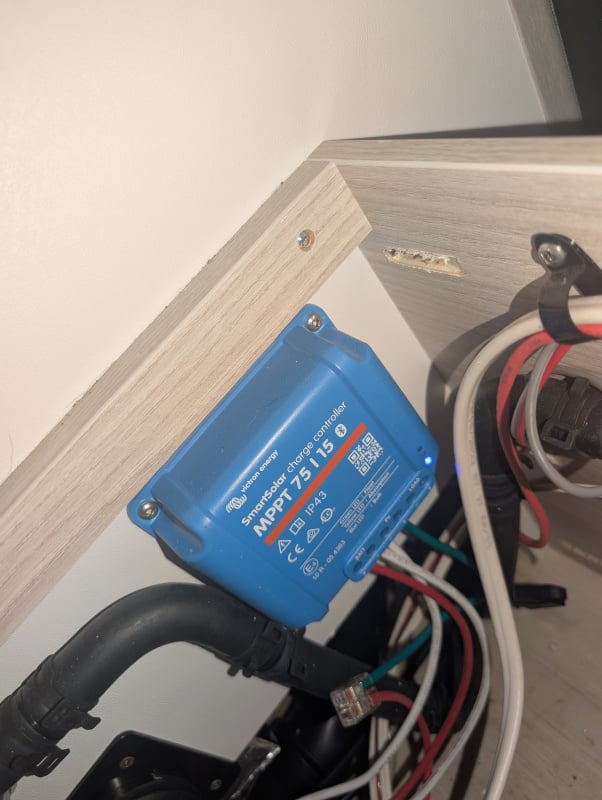
So I'd really like to run the fridge while boondocking. Doing it in the driveway it just looks like its pulling too much battery (isotherm). I want to switch batteries. I called nucamp early on about the lithium and they said there is some kind of software update for the controller (victron Smart Solar MPPT 75 l 15) that would require me to go to Ohio, which probably isn't happening. However, I have read here that I can still use lithium without the update, it just won't be optimized and that's honestly OK.
I'm considering doing it myself but I am decidedly NOT handy, especially with electricity. If needed I will pay someone but obviously I'm hesitant to take it back to the dealer who put me in this situation. Can a standard RV repair place handle something like this? Is it possible to drop in a new battery and then reset the controller via bluetooth to reflect the new battery type?
Alternatively, what about an AGM? Can I just unplug the marine cell (after covering the solar panel) and put in an AGM battery? From what I have read I might be able to run the fridge off of that or at least have better battery life (not that it has been a problem, but you never know).
I often get overwhelmed by the amount of detail given here (but I'm glad its available, no criticism !!!), I'm a lifelong backcountry truck camper who sucks at math and engineering. If anyone can plain English what my options are, I would appreciate it.
I hope everyone had a good camping summer. Thanks y'all.
Comments
-
OP here. I should note that I did look at the pdf currently posted here about installing lithium and it's waaaaay of my league. Kudos to that guy and all the rest of you. That's why I might need to get someone who knows what they are doing. However that pdf is titled RELOCATION of battery so I'm not sure it's applicable to my situation. I will review it further.
0 -
There is a lot of information that goes into excruciating detail about how to optimize every aspect of the electrical system. But at the most basic level you just switch out the battery and it will work. LiFePo batteries have many advantages over AGM (deeper discharge, more cycles, lighter, competitive if not lower prices). LiFePo batteries need a higher charging voltage (14.2-14.6V) and that's where the information overload starts because there are different possible ways to achieve this.
Option 1: Don't change anything. The battery will still work and get charged, just not to full capacity.
Option 2: Change the solar charge controller settings to LiFePo. Between the converter and solar the battery gets a full charge.
Option 3: Buy a simple (!) LiFePo charger which allows to fully charge the battery regardless of solar.
Newer T@bs have a converter that is supposed to detect LiFePo batteries and adjust accordingly but that appears to be hit and miss. Not worth changing the converter in my opinion.
1 -
We are assuming here you have a 320. With the battery in the front tub. Tell us exactly what battery you have. Or send a photo, we can tell. Honestly, when it comes right down to it: the terms "lead acid/AGM/deep cycle are interchangeable and really do not make "too much" difference. (I know, the electricians will be on my case in several minutes!) What does matter is: what size is the battery? A "Group 24?" A "Group 31". A "Group 24" is what the "stock" lead acid/AGM/Deep Cycle battery installed in the trailers before the battery revolution since around 2018. So, the size of the battery can make a difference. And, in general, many owners have those types of batteries (singly and in pairs, etc) and they work just fine with the compressor fridges.
So: exactly what battery?
What did you use to determine the power use of the Isotherm? With a lead acid battery, care must be taken when monitoring battery voltage, because a lead acid battery is always lying to you when you try to measure voltage if the battery is "on" or being charged.
Do not confuse the Victron app setup with the "WFCO converter setup. In your 2023, you probably have one of the "lithium compatible" converters. We can show you how to make those work, but I agree with Grumpy, a stand alone charger will be easy to deal with. I have a 2017 with a lithium battery, the same old non lithium converter. I use solar to charge my battery properly. All you need to do for solar to do the job is properly set up the controller for lithium charging. We have plenty of info on that.
How hard is it to upgrade? Take the old battery out. (Take a picture of the wiring at the battery). Put the new battery in. Set up the solar controller for lithium charging. And, done.
So, show us a photo of the battery, or tell us the model number, etc. A "Group 24" battery will have numbers on it like "DC24" or something. A Group 31 may have the same sort of numbers.
In any case, you are on the right track for a battery upgrade, no matter what may be installed in your trailer now.
PS: In Mouseketab's description, they were also installing a DC-DC charger. It is a beautiful install, and they are obviously pretty skilled at doing that sort of wiring, etc. There is nothing wrong with "keeping things simple". It sounds like all you really want to do is to be able to boondock with your two way fridge. A simple battery upgrade is really all you need.
2017 Outback
Towed by 2014 Touareg TDi0 -
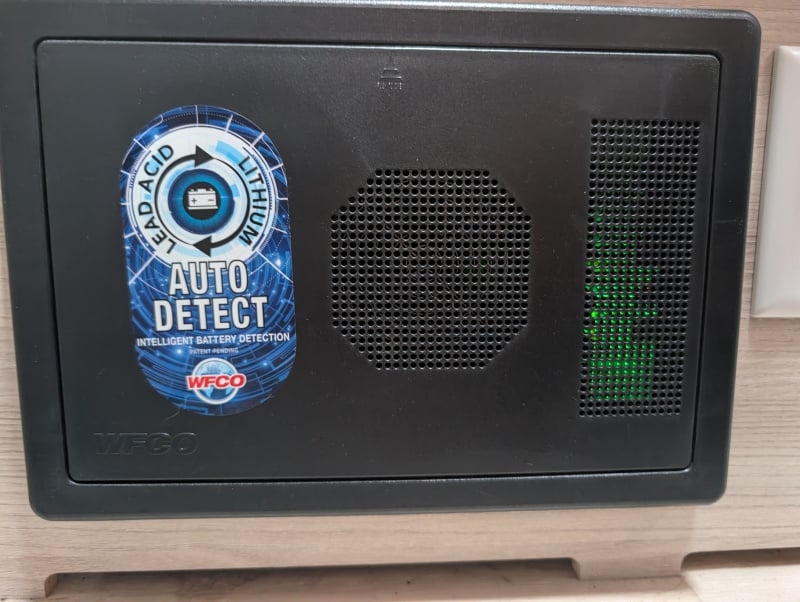
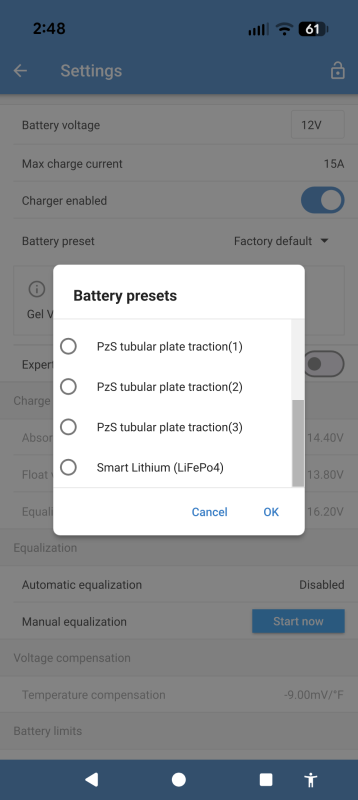
Thanks y'all. I'll try to respond to both of these comments on this post and then I'll use my phone to post the relevant photos. I have a 320S which was a "leaf and linen" signature series, whatever that means. The current battery is an SRM-24 deep cycle in a tub. I also have a Victron controller 75/15 with an app that lets me see the charging vs use on the battery. There's solar on the roof. There is also a WFCO thingie that I guess is the inverter. It says it will auto detect lithium to lead battery. Iirc this is the thing that needs some kind of update that you can only get done in Ohio and they weren't super pro-active about encouraging me to come get it. Not sure if it can even be done any more. The app on the victron allows me to choose from battery presets and one is the Smart Lithium (LifePo4) so I guess thats what I want. I definitely I want something that fits in the same spot as my current battery.
The current battery has been OK, it charges up well, usually up to pretty high 13 or even 14 and is on float status by mid-late afternoon (I need to check these numbers as I haven't paid much attention for awhile). Without a fridge we don't do much with it….charge phone, a little radio, run the fan for short spurts to clear heat but we have clamp on fans that fan us directly for sleeping. We use the water pump very sparingly. But I got spoiled on our last trip where we plugged in—keeping perishables in the fridge is pretty dang civilized.
Yesterday I ran the fridge on 3 while it was sunny with some haze and charging it with solar. It wasn't the sunniest day but certainly along the lines of what I might expect camping. It was staying in the highish 12s, not even getting to 13. I got home and it was round 9:30 and it was showing at 12.3 with no charge coming in (bc dark), which is pretty low. From what I have read you start to damage the battery if it goes much lower so I turned the fridge off. I ran it a little bit this morning just to gauge what setting gets me what temp but turned it off around 11.
Thanks for your interest and the info so far. I'd be curious to get your input. I'll send some photos and start reading up a little more.
0 -
-
Perfect! The battery you have is the "Stock" battery I mentioned: the Interstate "Group 24" 81 amp hour battery. My trailer had pretty much the same battery in 2017, and many thousands of owners since have them as the "stock" battery.
Your WFCO "converter" is the Auto Detect model. When the "Auto Detect" works, great. But, sometimes, the Auto Detect "forgets". And, it isn't very obvious that the converter is not working properly. There are work arounds, but that will be a different subject.
There are now tons of lithium batteries that will fit in your trailer. A couple of years ago, one company came out with a "Group 24" sized lithium battery that has a 100 amp hour capacity. Your lead acid battery has about 40 amp hours of "usable" power. So, a simple upgrade to a Group 24 100 amp hour setup will double your number of "usable" amp hours. Many lithium manufacturers have these Group 24 batteries available.
But: there are also "mini" lithium batteries that can carry about 300 amp hours, and fit in that same spot.
There are many companies making lithium batteries these days. In this group and many of the FB groups, owners have purchased batteries from LiTime, Vatrer, and WattCycle. Many of the big solar names have their own branded batteries: Renogy, for example. All of these companies sell Group 24 batteries. I have a "Redodo" brand battery I use as a "spare", and it works for me just fine. The choices can be a bit bewildering. But, check the specific web pages for each company, and look for the "Group 24" batteries. Many of these come with various "bluetooth apps" for monitoring, but I feel the Victron devices are much better at battery monitoring.
Your two way fridge uses "maybe" a couple of amps per hour. If you had decent sun on your panels, the solar was able to recharge your battery and run the fridge and other devices at the same time. All of those voltages you mention were well above the "50 percent" mark that is usually what owners look for "best battery lifespan". It sounds like you have a good handle on battery use.
Towed by 2014 Touareg TDi0 -
Thanks pthomas. Don't you think running the fridge all night would draw the battery down too much? Daytime is no problem but I felt like another 8 hrs of use before drawing a charge again might be a problem.
I see that the "group 27" size lithium is only about a little bigger than the 24. I'd measure the space with the battery box to make sure but would it be better to get one if those? It matched the one on my victron presets and I like that.
What does "smart lithium" mean with Victron? Does is matter? Can I use that preset with any lithium?
So....to swap it out..throw a blanket over the solar panel, turn off battery switch, take photo of wires and just stick it in there and put the wires back where they were? Change Victron setting to the new battery? Anything I need to know about getting it restarted? Anything I need to do with WFCO?
Thank y'all so much.
0 -
NOTE : I edited the title of the Thread to make it easier for folks to search moving forward.
If you pick a lithium replacement of more than 240 amp hours you will likely never run down the battery if you have solar since the 2 way frig uses only 20-40 amp hours per 24 hour day. That would nearly use all the current battery but will use only 1/5 of the 240 amp hour size capacity which the solar will make up for with reasonable sun exposure.
As far as swapping out. Just take a photo, disconnect all power and turn off the battery switch and have the panels out of the sun and take your time. It is hooked up very much like your car battery. Remove the Neg wire first and then the Pos and keep it away from any potential grounds. if there are other wires just keep them all together and reverse the process when you drop the new battery into place. Others can advise on changing settings but if your WFCO does work it should detect the lithium voltage and charge accordingly when on shore power. If not then the solar controller settings can be changed in the app for the Victron and they will charge to the lithium standard voltage.
The only reason to fully charge a lithium as far as I know is for the built in battery management system (BMS) to balance all the battery cells at 100%.
Others will know more specifics if you have questions. Good luck.
2019 T@B 400 Boondock Lite towed by 2016 5.7L Toyota Tundra
0 -
Thanks. I'm pretty excited about this.
0 -
The Victron settings for the various batteries refer to the batteries Victron sells, as far as I can tell. We can show you how to use the "expert" mode to set up the lithium batteries with more specific parameters. The "presets" will work fine, but since the introduction of the batteries with the various bluetooth apps, it seems there is some confusion about what is meant by the "Smart Lithium" settings.
What you should do is: pull the fuse at the solar controller that comes down to from the solar panels. That will completely shut down the solar. There is a proper way to connect a battery to the controller. Make the new settings in the App for the Victron charging parameters. Then, connect the battery and use the App to see that the controller has read the voltage of the battery. Then replace the fuse at the solar controller for the solar panels.
The WFCO requires a procedure that basically runs the battery down to a fairly low level. Then putting the trailer on shore power, and then the WFCO model you have "automatically detects" there is a lithium battery to be charged, and it is supposed to charge it to an appropriate higher voltage. Sadly, the WFCO is simply not very good at this, and that company blames everything except phases of the moon for their poor design.
Towed by 2014 Touareg TDi0 -
Ok, I'll look for vids on this fuse thing but any tips would be good. I did just order a box of random RV fuses too so I'm fuse yeah.
0 -
Haven't read all the posts in this thread, but saw the comments on size and battery boxes. I had used the box linked to below for my 100Ah battery, but switched to 300Ah. Due to the upper dimensions the new battery would not fit all the way into the box. Rather then try to squeeze a larger box into the space, I cut down my old ones so that they prevent the battery from shifting and use a nylon strap over the top.
https://www.amazon.com/dp/B0024E72GA?ref_=ppx_hzsearch_conn_dt_b_fed_asin_title_19&th=1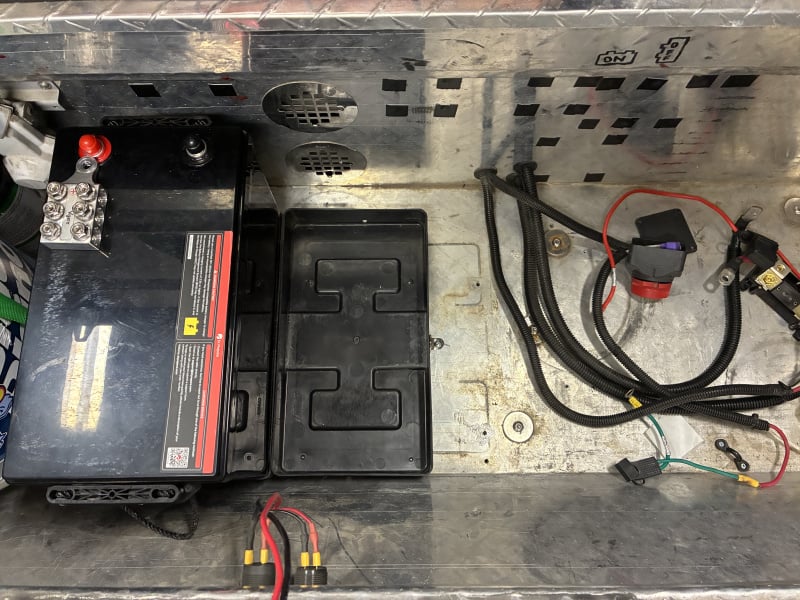
Stockton, New Jersey
2020 nuCamp T@B 320S * Jeep Wrangler
60,865 camping miles through the end of 20250 -
Stockton, New Jersey
2020 nuCamp T@B 320S * Jeep Wrangler
60,865 camping miles through the end of 20250 -
The fuse at the solar controller is in a standard 30 amp fuse holder at the controller. Looks like this one.
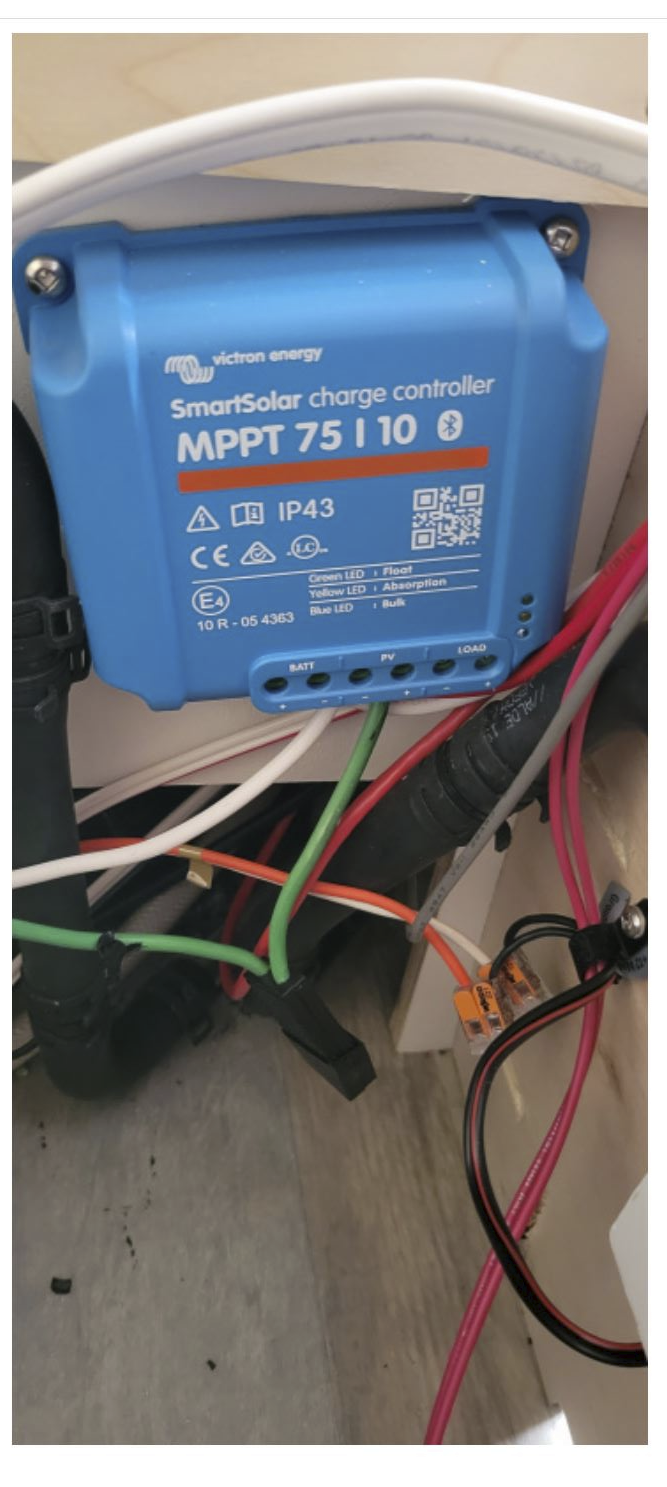 Towed by 2014 Touareg TDi0
 -
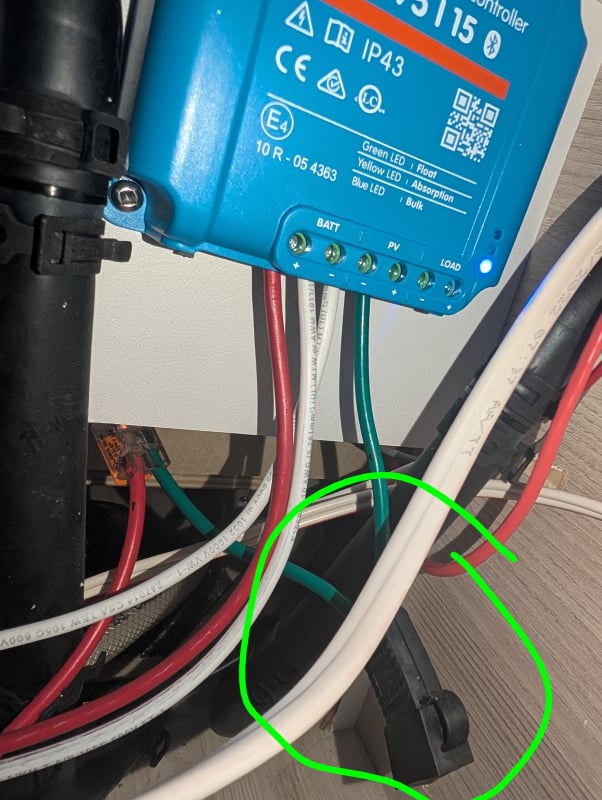
This thing? Just pull it out, do the stuff and then put it back? Nothing else to get it restarted or anything?
 0
0 -
That is it. The Victron manual has pretty specific instructions on how to connect a battery to a solar controller. And, basically, the order is connect the battery first, so the Victron can determine the voltage of the battery. After the Solar controller knows the voltage of the battery, then put the fuse back in at the controller for the solar panels, and the controller knows how much of a charge to send to the battery.
Towed by 2014 Touareg TDi0

 2017 Outback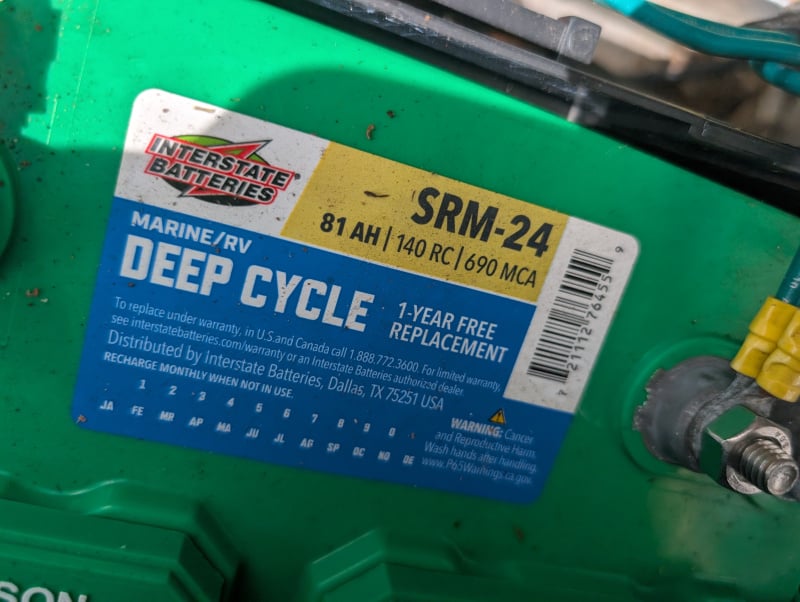


Categories
- All Categories
- 11 Cirrus Truck Campers
- 127 Dutchman and Vintage TaB Archives
- 3 Forum Rules
- 3 nüCamp & Forum Contacts
- 967 Air Conditioning & Refrigeration
- 2.7K Battery/Electrical & Solar
- 1.2K Camping & Travel
- 145 Events & News
- 220 Factory Comments
- 24 "FOR SALE" - New/Used Trailers
- 12 “FOR SALE" - Camping & Trailer Gear
- 2.4K Heating/Plumbing & Winterizing
- 142 Help - Computer & System
- 924 Introductions
- 408 Looking to purchase a trailer?
- 2.1K Modifications & Upgrades
- 1.4K Products and Accessories
- 419 Service/Maintenance & Recall Notices
- 37 Solo Travelers Hints & Tips
- 1 T@G Forum
- 77 Teardrop Groups & Links
- 78 Testimonials
- 922 Tips & Tricks
- 1.5K Trailer & Towing
- 27 Owners Manuals/PDF Files/Videos & Resources
- 56 üCamp Rally - News & Information