
2023 TAB 400
Relentlessly Pursuing a Silverado EV
'Racing the Wind and Chasing the Sun'
Virginia Beach, VA
Categories
- All Categories
- 9 Cirrus Truck Campers
- 117 Dutchman and Vintage TaB Archives
- 3 Forum Rules
- 3 nüCamp & Forum Contacts
- 944 Air Conditioning & Refrigeration
- 2.6K Battery/Electrical & Solar
- 1.2K Camping & Travel
- 142 Events & News
- 219 Factory Comments
- 17 "FOR SALE" - New/Used Trailers
- 14 “FOR SALE" - Camping & Trailer Gear
- 2.3K Heating/Plumbing & Winterizing
- 133 Help - Computer & System
- 914 Introductions
- 407 Looking to purchase a trailer?
- 2.1K Modifications & Upgrades
- 1.4K Products and Accessories
- 398 Service/Maintenance & Recall Notices
- 37 Solo Travelers Hints & Tips
- 1 T@G Forum
- 72 Teardrop Groups & Links
- 77 Testimonials
- 912 Tips & Tricks
- 1.5K Trailer & Towing
- 27 Owners Manuals/PDF Files/Videos & Resources
- 62 üCamp Rally - News & Information
Is Plug-in Solar Feasible for a T@B?
 RTWCTS
Member Posts: 194
RTWCTS
Member Posts: 194
Recently I've seen a few articles/videos on plug-in solar. The basic concept is that solar panels attach to a microinverter (converting the voltage to 120V AC). The electricity then passes through a plug and into a standard 120V outlet. This feeds the loads in a 120V circuit. It appears to be quite popular in Europe. According to a segment on PBS (link below), Utah recently made it legal for home use and legislation has been introduced in other states.
Small plug-in solar panels gain traction as an affordable way to cut electricity bills | PBS News Weekend
Could this work as a plug and play solution to augment power in a T@B through the outside receptacle? Would it power the converter to charge batteries? Let me know your thoughts...
Small plug-in solar panels gain traction as an affordable way to cut electricity bills | PBS News Weekend
Could this work as a plug and play solution to augment power in a T@B through the outside receptacle? Would it power the converter to charge batteries? Let me know your thoughts...
Comments
2025 KZ Sportsmen 130RD
2025 Ford Ranger
The Finger Lakes of New York
2013 CS-S us@gi
2015 Toyota Tacoma PreRunner Double Cab
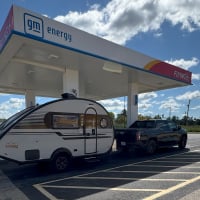
To be sure, we don't need to add this plug-in concept to our 400. The factory rooftop solar and our briefcase panels can keep us energized long term while dry camping. Our only (electrical) shortcoming was keeping cool in the summer. We solved that when we bought our Silverado EV. Now on hot days we just plug the T@B into the 30A outlet in the bed of the truck and have AC power to spare.
Guess I'm just suffering cabin fever right now... c'mon warmer weather!
Relentlessly Pursuing a Silverado EV
'Racing the Wind and Chasing the Sun'
Virginia Beach, VA
Relentlessly Pursuing a Silverado EV
'Racing the Wind and Chasing the Sun'
Virginia Beach, VA
Adding in agreement: these are "grid-following" devices, which match their voltage level and phases to the circuits they're plugged into. The main safety reason is to prevent feeding into the grid when there could be utility workers touching the presumably dead lines.
There are "grid-forming" 240V devices designed for off-grid and backup of grid-tied applications; they have extra electronics. They cost more, and are hard or impossible to find at the moment for end-user mobile and RV 120V applications.
2018 T@B 320 CS-S; Alde 3020; 4 cyl 2020 Subaru Outback Onyx XT
Cheaper, cleaner energy drives Germany's balcony-solar boom – DW – 12/18/2025
They seem to be, in fact, for grid tie systems and are used frequently in Germany. I do believe reading that they have built-in protection to keep them feeding back into the grid (but would have to search for confirmation saying so).
With them being legal in Utah and under consideration in other states (see link in my original post), it just got me thinking about potential uses. That was why I asked the original question. No harm or foul if it doesn't work in a trailer. This is just a cool concept I was learning about while stuck indoors.
Relentlessly Pursuing a Silverado EV
'Racing the Wind and Chasing the Sun'
Virginia Beach, VA
I'm glad that "balcony solar" has gotten clearance in Utah. We already have PV at home. An plug-in addition could be useful, if priced right. However, for a camper, one of those "solar batteries" which includes an inverter would probably cost less.
@Grumpy_G mentioned the danger of the exposed blades of the plugs. That's a real risk: the wiring for a generator to plug into your house (plugs at both ends of an extension cord) is called a "suicide cord" for good reason.
2018 T@B 320 CS-S; Alde 3020; 4 cyl 2020 Subaru Outback Onyx XT
Key Features of H.B. 340
Definition and Specifications
- Portable Solar Generation Device: Defined as a movable photovoltaic system.
- Power Output: Maximum of 1,200 watts.
- Connection: Must connect to a standard 120-volt outlet.
- Safety Features: Must include anti-islanding protection to prevent energizing the electrical system during a power outage.
The fourth bullet point is why plug-in solar won't work in a trailer. Also, the are no energized blades in the plug (no "suicide cord" capability) until after it connects and detects voltage present.My (limited) understanding of generators and house wiring is NEC requires a transfer switch. The main power has to be turned off for the transfer switch to be activated and allow generator power into the house lines. If the generator is off and transfer switch engaged when plugging a generator in to the transfer switch, I don't understand how you can be shocked as there is no electricity source.
Ultimately though, plug-in solar is not a solution for powering a trailer while dry camping. Thanks for the insight!
Relentlessly Pursuing a Silverado EV
'Racing the Wind and Chasing the Sun'
Virginia Beach, VA
What all the hype videos show is you can hook up four solar panels up to 1200 total Watts. What they don't tell you is that Ecoflow's instructions tell you that 1200 Watts requires a dedicated 50 amp circuit with 6 AWG wiring...something that almost no home is going to have available. At 360 Watts, Ecoflow tells you you can plug into a dedicated 15A circuit. At 480 Watts, it needs a 20A dedicated circuit. At 720W it's a 30A dedicated circuit. At 900W it's a dedicated 40A circuit. Dedicated means the circuit can't have any other power being drawn. Circuit breakers can't sense incoming current so you could easily overload a circuit by injecting power into a line that's also carrying current for another device. Our house has zero circuits that I can dedicate to plug-in solar, so if I don't sell the Ecoflow inverter first, I'll have to install a circuit with suitable capacity. Since I imagined putting rigid panels on the roof of our separate garage, that would entail running a new 50A circuit to that building using buried conduit. Hardly "plug and play".
The anti-islanding feature would turn off the inverter when a trailer isn't connected to shore power, so this kind of microinverter makes no sense for RVs. If you're on shore power, why do you need solar?
I have a second Victron solar controller on our trailer that is far lighter and less expensive than the Ecoflow balcony solar device. The Victron 15A solar controller works great with our 200W solar suitcase. I can also plug in DC from our Bluetti Charger 1 device in our tow vehicle (with the Charger 1 set within our Victron's 75v voltage limit).
2023 T@B 320 S Boondock