Please Convince Me...Winterizing Strictly With Air

Every Fall I buy antifreeze and winterize our 2021 Tab 400 the "hard way". I don't mind it but it sure adds a lot of work come spring when I dewinterize the camper.
I normally blow the lines out with air BEFORE adding antifreeze so I know I'm not diluting any of it but would I be fine simply blowing out the lines with water and calling it good? I get paranoid about pooling water in lines but if I can skip antifreeze altogether I'd be a much happier person come spring.
Convince me!
2020 Tacoma TRD Off-Road
Comments
-
Where exactly do people think this "mythical" pooling of water might happen? And, how much water can possibly still be left? Owners have used the blowout method for years and years. The Tabs have fairly short runs of plumbing, and between the draining process (gravity) and the compressor (force) there can only be a tiny amount of water left in the trailer in any case. The blowout method would still require a bit of antifreeze in various places in the trailer, such as the non-Hepvo drain traps, and some worked down into the black and gray tank valve setups. The pump needs to be drained, to check if anything if left after the blow out. Those of us with regular toilets need to ensure the toilet valve is "blown out", also.
The older threads about the blow out method that are still up in the Winterizing section of the Forums all have "blowout" instructions.
2017 Outback
Towed by 2014 Touareg TDi0 -
Although, I live in the Southeast (central NC) and our winters only have a few days of dropping in the teens (Fahrenheit), I've only done the blowout method on my T@b 400 and never had issues. I am intentional to do the extras @pthomas745 mentions. I'm extra sure to blow out any remaining water in that toilet valve as that one is notorious from breaking if it freezes. I've never had issues. I followed the same method in my previous non-nuCamp trailer without issue, too. To protect the seal in the toilet I often have to pour more antifreeze in the bowl as it often evaporates away, but that's not a freeze risk as much as a seal-drying-out risk. It sure is nice not to have to mess with the antifreeze in the pipes.
2024 T@b 400 BD "Tabba the Hut"
2022 Nissan Pathfinder
Cary, North Carolina0 -
After the Air-Blow-Method any remaining water will be drops not several ounces. Even if it was ounces keep in mind:
- with low point drains open there is lots of empty space for ice to expand into
- PEX tubing does withstand some expansion pressure without failing, just encase the ice did not fully expand along the pipe/tubing
I've used a modified Air-Blow-Method for years in an area with 20°F nights.
Modified:- add anti-freeze to water pump only, just as insurance
- add anti-freeze water mix to P-traps to block smells (older TAB with standard P-Traps)
'18 320 S, pitched axle, 3020HE; PNW based
TV: '17 Colorado V6 Z71 4x4, Tow Package, GM Brake Controller
TV: '25 Canyon AT4
Adventures: 61 Nights: 417 Towing Miles 51,0501 -
The key to using just the blow out method is that you need to have high air flow from the compressor to push the water out. Those small 12V pumps don't push enough air. Even with a pancake compressor, I would pressurize it multiple times while I'm blowing out the various faucets, showers, and toilet.
Also, air doesn't freeze. ;)
Rich2019 T@b 400
2025 Toyota Highlander 2.4L TurboBellingham WA1 -
Gosh I didn't blown any air through my lines. Just flushed with water and poured in RV antifreeze. Am I missing something haha? I live in the coldest part of the nation, Gunnison CO. But am headed to AZ for the winter :)
0 -
@nooch Welcome to the Forums. You need to let us know what year and model of trailer you have, since the combinations and permutations of Nucamp trailers are off the scale. We can help with winterizing advice.
Towed by 2014 Touareg TDi0 -
Thanks so much for your quick reply. I just purchased a 2022 Tab 400 Boondock. My biggest issue right now is the smell from the grey water tank. I just made another post about what I've been doing since I bought the camper to eradicate the smell (but I think it's in two places ). I live in the Colorado mountains in one of the coldest towns. Wondering about the air valves under the sinks.
0 -
@pthomas745 Is there a definitive guide on the forums for doing a blowout? The only thing you said that tripped me up was about draining the pump and somebody mentioned the toilet valve?
Edit: I found some guides for other Tabs but not the 400.
2021 400 BD
2020 Tacoma TRD Off-Road0 -
This is easy. The toilet is cleared the same way as the other lines. Pressurize the trailer with air and flush. The air pushes the water through.
The instructions for the water pump are in all the NuCamp manuals. They appear to be close to the same for all trailers. For the 320CS, disconnect the lines on both sides of the pump. The one side will drain out the low point drain. The other side drains back to the tank and out the tank drain. What was in the pump is now on the floor… Remove the pump filter, the clear bowl.
If your trailer has P-traps, poor some antifreeze down the drain to fill the trap.
2018 320CS-S
"Just Enough"1 -
If you use anti-freeze in your lines, there is no need to use the blow-out method. The antifreeze will do a perfect job of flushing out all of the water in your lines. You might save a splash or two by pre-blowing the lines, but the effort hardly seems worthwhile. If you have ever experienced a frozen line and had to deal with faucet or valve damage due to freezing, you would probably have no problem springing for an extra jug of antifreeze.
The blow-out method is not fool proof. Arguments that only a small amount, a few drops of water remain are silly. That few drops in the wrong place (in a valve) will cause damage when it freezes. Been there, done that. It can be a big pain to repair freeze damage. If you live in a modest climate, you might get away without using antifreeze, but if you experience real freezing conditions, eventually you may experience a problem.
Most home air compressors do not have moisture filters on them. They blow unfiltered compressed air, that contains moisture. Depending upon the humidity when you blow out your lines, you could actually be adding moisture back in while you blow out the lines.
It's a choice.
0 -
@tabiphile This is what I've always done (anti-freeze) but just looking for a potentially easier route to go. It would save time and effort not dealing with anti-freeze but I get your point…anti-freeze is an almost guarantee that nothing will freeze. We also live in a fairly harsh winter climate.
2021 400 BD
2020 Tacoma TRD Off-Road0 -
IMO syphoning antifreeze is worth it to avoid the time and trouble of draining the water pump. Once you get your siphoning technique down, it’s not that big a deal to pump the water lines full of antifreeze. And in doing so you protect the pump as well.
2021 400 BD / 2023 Ford F150 / Austin, TX
0 -
This is how every winterizing thread goes. Back and forth. "You are doing it wrong", whether that means the wrong compressor, or the wrong antifreeze, and on and on. If the "blowout method" caused havoc and destruction, we would know. The only "mistake" on the winterizing issue is….not winterizing.
The pump "draining" is covered in the Shurflo pump manual. Simply drain the trailer, run the pump for a moment, and then disconnect the inlet and outlet hoses at the pump. See #3. This is what "Mickerly" was describing in their comment.
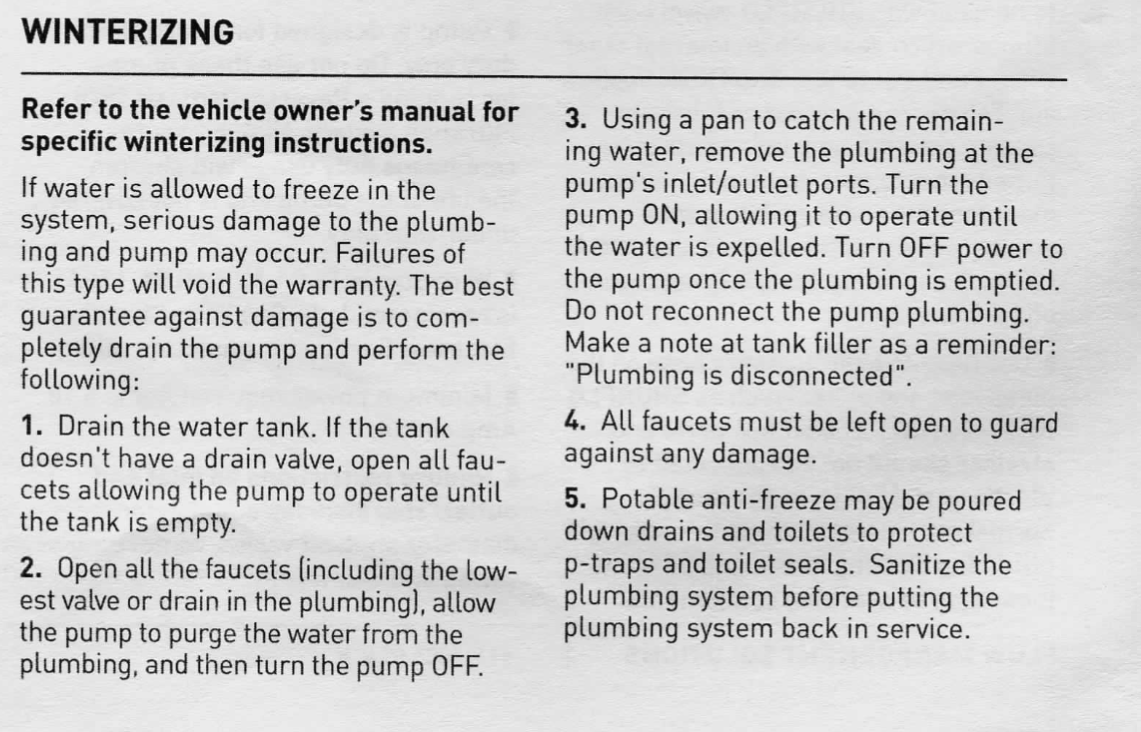
There are dozens of "blow out" method threads from many owners. All of the little "tricks" are covered: the dreaded toilet valve, the pump, the traps, etc. And, running through all this issue again over the last few weeks, there is tons of good info. One of the more complete run throughs of the blow out method is from an owner who offered his own commentary on how the winterizing methods became so convoluted. Warning: there are opinions here! When you read over this, keep in mind this owner's trailer was a 2016, so newer trailers will be configured differently, and after the Nautilus was introduced, most of this doesn't apply. See "Winterizing 103".
We can go back even farther, with the owners who used to use the blow out method with…bicycle pumps. This owner, "Pop-Tab", made a "blow out compressor" by modifying a gardening spray pump to attach to the city water connection that they used to introduce RV Antifreeze or to "blow out" the lines. I recently made one of these, and used it to sanitize my trailer. It works easily. (I made a slightly improved sprayer with the help of YouTube that holds the pressure a bit better).
Pop-Tab's Winterizing and Sanitizing Pump Sprayer
In the very early NuCamp/Little Guy manuals, they suggested using some sort of handheld pump to deliver the RV antifreeze directly to the lines in the same manner at Pop-Tab's sprayer. After all the endless comments of how the "Nautilus Will Not Pump Antifreeze" Nucamp actually has a video out that recommends using an "RV Hand Pump". Even those techs are probably tired of answering questions about why the Nautilus cannot do this simple chore without having to do Tab Aerobics. Everything old is new again: this is basically the same device that NuCamp shows in the older 2014 Winterizing manuals. Link goes to the NuCamp YouTube channel.
Tech Talk: How To Winterize With An RV Hand Pump
I can also find a lot of posts about how NuCamp used to recommend the blow out method.
Towed by 2014 Touareg TDi1 -
We live in North Texas. It does get below freezing, normally not below 20F. It stays cold for 3 or 4 days. Rarely more then 10 days. In between the freezes, is great camping weather and the "summer only" campers are gone. If we were using anti-freeze, we would be winterizing a half dozen times each winter. We use a through blowing out. Blowing out doesn't reach everything. The water pump and waste traps are two examples. If you are somewhere where the weather stays below freezing for the winter, there are other considerations.
There are no absolutely correct answers or completely wrong answers. Blowing out works, if you take the time to hit all the areas water will hide. We blow-out twice. Then a third time if we were still getting water. If there is no water in the trailer, there is nothing to freeze. A couple drops freezing will not do any damage. A filled elbow or valve freezing will. Anti-freeze works too. It needs to be thoroughly flushed out before resuming use. I'm sure someone can find hybrid methods of partial blowing and partial antifreeze that also works. This debate has been around since the 70's when Winnebago service departments started offering "Winterizing Services" with anti-freeze.
As mentioned above, this thread is a re-run. Being knowledgeable of the tools available allows you to do what works best for you.
2018 320CS-S
"Just Enough"0

 2017 Outback


Categories
- All Categories
- 12 Cirrus Truck Campers
- 128 Dutchman and Vintage TaB Archives
- 3 Forum Rules
- 3 nüCamp & Forum Contacts
- 972 Air Conditioning & Refrigeration
- 2.7K Battery/Electrical & Solar
- 1.2K Camping & Travel
- 145 Events & News
- 220 Factory Comments
- 27 "FOR SALE" - New/Used Trailers
- 15 “FOR SALE" - Camping & Trailer Gear
- 2.4K Heating/Plumbing & Winterizing
- 138 Help - Computer & System
- 925 Introductions
- 409 Looking to purchase a trailer?
- 2.2K Modifications & Upgrades
- 1.4K Products and Accessories
- 430 Service/Maintenance & Recall Notices
- 37 Solo Travelers Hints & Tips
- 1 T@G Forum
- 78 Teardrop Groups & Links
- 78 Testimonials
- 923 Tips & Tricks
- 1.6K Trailer & Towing
- 27 Owners Manuals/PDF Files/Videos & Resources
- 56 üCamp Rally - News & Information