
Stockton, New Jersey
2020 nuCamp T@B 320S * Jeep Wrangler
60,865 camping miles through the end of 2025
Victron SmartShunt

Explorers2
Member Posts: 41
Today I will mount a Victron 100/20 controller in the space under the port side seat, connecting existing wiring to solar panel and battery. I’m working out how to wire up the Victron SmartShunt that will arrive in a few days. Through meter testing, it looks like the wires that come from the solar controller go straight to the battery. So my plan is to wire the shunt into the negative side battery wire coming from the controller, and then mount the shunt beside the solar controller. Does anyone see any issue with that plan? Seems like it would be a clean install with no weather issues.
0
Comments
-
All negative wires for the battery need to terminate on the load minus side of the shunt and then one wire should go from the battery minus side
of the shunt to the battery negative terminal. It probably makes more sense to late the shunt closer to the battery minus side.2 -
I just found this old diagram in my files. What size is the negative wire from the controller? I ended up using a negative bus bar to clean up the wiring.

1 -
I just installed the Victron BVM-712 smart shunt in my tab 320s. As a stated by skibug above “All negative wires for the battery need to terminate on the load minus side of the shunt” I ran across one piece of advice I found on an Australian overlander website which is to install the shunt close to your batteries to keep the leads short and minimize voltage losses in the wiring to the shunt. Granted the Tab 320 is very small so you won’t really be that far from the batteries no matter where you place the shunt.2023 T@B 320s Boondock, 2013 Toyota Tacoma TRD 4x4 2016 Toyota Tundra 1794 4x4
John, Northern California1 -
Okay thanks. I was trying to deal w the water / weather issue but I see I’ll need to mount it up by the battery. I’ll figure out how to protect it from water. Thanks for the added info.Right now I’m strategizing on how to get those 10ga wires cleanly into those tiny holes in the 100/20! Ha! Nothing is ever easy in DIY Land!1
-
I ran into the issue of trying to squeeze 10 gauge wire into those tiny holes on the solar controller. First I tried twisting them tightly and insert them carefully, nope, wires kept fraying spilling out. Then I bought a ferrule set (been wanting one anyway) but couldn’t find a pin that fit 10 gauge wire and crimp down small enough to fit in the controller. I got a wild idea and ended up tinning the wire ends with just solder and then using the ferrule crimper on that, lol! It worked but took a few squeezes…2023 T@B 320s Boondock, 2013 Toyota Tacoma TRD 4x4 2016 Toyota Tundra 1794 4x4
John, Northern California0 -
This works -> clean cut w good wire cutter. Trim 1/8” only with sharp wire stripper. Don’t do anything to the ends, no twisting or mashing,
just insert them into the little holes. They go right in up to the trimmed insulator. Pull firmly once screwed down to confirm tight joint. Clean install.2 -

0 -
All done w 100/20 install. Works great
Do you guys know what gauge wire I will need from the shunt to neg battery terminal? I thought I’d make that up in advance.
0 -
@Explorers2 That would depend on the loads going to the battery and the length of the wire between the shunt and battery. For instance, if you have an inverter that draws a high current, you’d need a minimum of the same wire size feeding the inverter.1
-
I am suprised that you had issues with 10 awg wire. My two solar chargers are wired to the battery using 8 awg wire. I had no issues whatsoever inserting the wire into the solar controller.TourDeForth said:I ran into the issue of trying to squeeze 10 gauge wire into those tiny holes on the solar controller. First I tried twisting them tightly and insert them carefully, nope, wires kept fraying spilling out. Then I bought a ferrule set (been wanting one anyway) but couldn’t find a pin that fit 10 gauge wire and crimp down small enough to fit in the controller. I got a wild idea and ended up tinning the wire ends with just solder and then using the ferrule crimper on that, lol! It worked but took a few squeezes…_____________________________________________________
Ken / 2023 Tab 400 “La Bolita” (39,000+ miles) / 2024 Toyota Sequoia1 -
I used 10 gauge zip wire from Powerwerx to run to my new battery location under the bed next to the air conditioner. The wire strands seemed a little thicker than what I’m used to with 10 gauge wire.2023 T@B 320s Boondock, 2013 Toyota Tacoma TRD 4x4 2016 Toyota Tundra 1794 4x4
John, Northern California0 -
What gauge wire did you end up using between the shunt and the neg battery terminal? I have a Victron smart shunt on the way and need to make up a cable. Thanks.Explorers2 said:All done w 100/20 install. Works great
Do you guys know what gauge wire I will need from the shunt to neg battery terminal? I thought I’d make that up in advance.0 -
If you match the wire gage used from the battery positive to the cut off switch you will be good. This wire size is dependent on the converter and possibly other accessories installed.rockyonekc said:
What gauge wire did you end up using between the shunt and the neg battery terminal? I have a Victron smart shunt on the way and need to make up a cable. Thanks.Explorers2 said:All done w 100/20 install. Works great
Do you guys know what gauge wire I will need from the shunt to neg battery terminal? I thought I’d make that up in advance. 0
0 -
The caveat I'd add to this is that inverters are sometime wired directly to the battery or a bus bar with a separate wire going to the cutoff switch. The wire going from the battery to the shunt should allow for the maximum total load that will pass through the shunt. That may not be the wire size going to the cutoff switch.rfuss928 said:
If you match the wire gage used from the battery positive to the cut off switch you will be good. This wire size is dependent on the converter and possibly other accessories installed.
Stockton, New Jersey
2020 nuCamp T@B 320S * Jeep Wrangler
60,865 camping miles through the end of 20252 -
I used an 4 awg jumper (6” w/ M8 Ring terminals) as every to and from battery runs through this. Overkill? Yes but good peace of mind. Matches capacity of shunt. https://www.amazon.com/dp/B0CY8LNGVQ?ref=ppx_pop_dt_b_asin_title&th=1Ultimate Toys Teardrop Camper
Volvo XC-40
SF Bay Area, California1 -
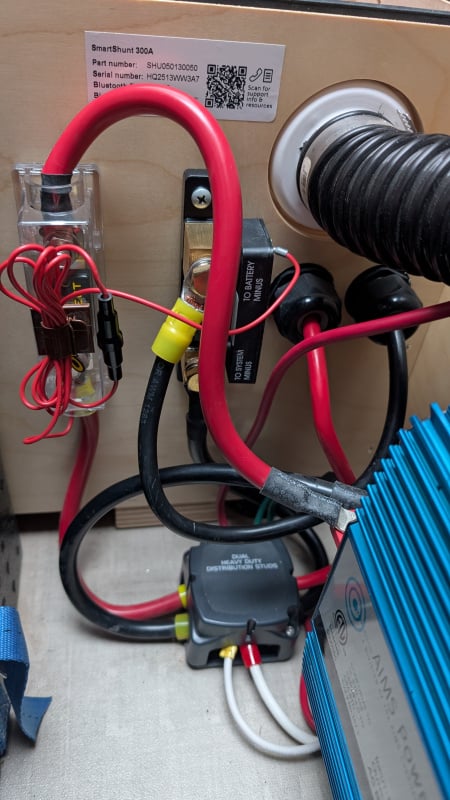
I bought that same 4AWG cable but with M10 and 11.8". This is on my 2020 Tab400. I put the shunt between the battery and the factory distribution studs. I moved the inline fuse going to the inverter over a bit to make room for the Smart Shunt as well as re-organized the wires on the distribution studs.jbajor said:I used an 4 awg jumper (6” w/ M8 Ring terminals) as every to and from battery runs through this. Overkill? Yes but good peace of mind. Matches capacity of shunt. https://www.amazon.com/dp/B0CY8LNGVQ?ref=ppx_pop_dt_b_asin_title&th=1
 0
0 -
I know I’m missing some understanding of the value of smart shunts…I have two 100 amp lithium batteries with BMS connected via bluetooth. They tell me the % of battery charge and cell voltage. I don’t have real time amperage draw but can work it out by recording time and actual SOC. I’ve never in 50 years of boating or rv’ing ever suffered from an occasional low voltage battery. Do I need a smart shunts, if so why?400 - 2019
St Catharines, ON0 -
@RCB I bought a shunt, because I had a leech draw. I got 2x 100Ah lithium, and they were dead in just 2 days. At the end I found the issue and I solved it.The batteries have their own app which shows me the charge... but it seems to be always showing 100% while the shunt is more reliable.If you have no issues with your setup I don't think you need anything to change.
Tab 320s Boondock 2022 | Jeep JKU 2017
Mods: MaxxAir 7500S | 2x 100Ah LiFePo4 | Victron MPPT 75/15 | Ultimate Trailer Jack0


Categories
- All Categories
- 10 Cirrus Truck Campers
- 122 Dutchman and Vintage TaB Archives
- 3 Forum Rules
- 3 nüCamp & Forum Contacts
- 956 Air Conditioning & Refrigeration
- 2.6K Battery/Electrical & Solar
- 1.2K Camping & Travel
- 142 Events & News
- 219 Factory Comments
- 21 "FOR SALE" - New/Used Trailers
- 13 “FOR SALE" - Camping & Trailer Gear
- 2.4K Heating/Plumbing & Winterizing
- 140 Help - Computer & System
- 921 Introductions
- 408 Looking to purchase a trailer?
- 2.1K Modifications & Upgrades
- 1.4K Products and Accessories
- 409 Service/Maintenance & Recall Notices
- 37 Solo Travelers Hints & Tips
- 1 T@G Forum
- 75 Teardrop Groups & Links
- 78 Testimonials
- 918 Tips & Tricks
- 1.5K Trailer & Towing
- 27 Owners Manuals/PDF Files/Videos & Resources
- 55 üCamp Rally - News & Information