

2014 S Maxx
2011 Tacoma 4cyl ... edit: 2022 Tacoma 6cyl - oh yeah!

A_Little_T@b'll_Do_Ya

This information was passed along to me by the factory and they asked that we share this with forum members, so please take a few moments to read it:
If your trailer is 1 year or older, we want to encourage you to properly maintain it. As you prepare for the camping season, it is vital that you do this – and it’s the perfect time before you start travelling/camping.
Perhaps the most important thing you can do is to check the seals. If any of the seals are cracked, you must re-caulk them. From time to time we have clients contact us with 2 and 3 year old trailers that have experienced some level of water damage. Upon investigation, the reason, more often than not, is that they did not stay on top of the seals. We don’t want anyone to experience water damage – it can lead to something ugly, like stained or swollen wood or something horrendous like an entire floor or sidewall replacement, depending on the trailer.
For those of you that have T@Bs, please pay close attention to 3 areas more vulnerable to water than anywhere else:
1. Under the wheel well
2. Behind the fender - caulk between the sidewall and wheel well – there is a great amount of flex/movement at this location and it will break the seal.
3. Under the door frame
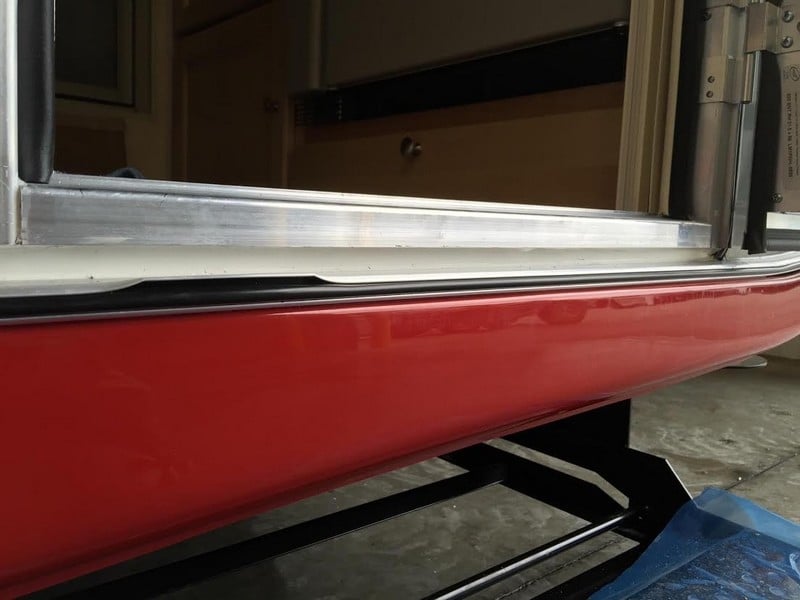
4. Please refer to the attached photos to show exactly where we are advising you to re-seal on an annual basis.
As always, you can contact our warranty and repair departments for assistance in any matter:
warranty@nucamprv.com repairs@nucamprv.com



2021 T@b 320 Boondock "Mattie Ross" | 2021 T@b Nights: 239 | Total nights in a T@b 455 | 2022 Jeep Grand Cherokee L Overland | T@b owner since 2014
2021 T@b 320 Boondock "Mattie Ross" | 2021 T@b Nights: 239 | Total nights in a T@b 455 | 2022 Jeep Grand Cherokee L Overland | T@b owner since 2014
What a great idea! I'd bet this would get a lot of people who've bought trailers in the previous year.kybob said:Thank you, Mike. This would be something nice that they could show us how to do in person at Tearstock. It would be nice to have a general maintenance workshop sometime during the event.
1. Door. Yes, under the silver door frame, not under the (red) trim.
2. Fender. There was no picture of that. If you look at your trailer from the side, you will need to remove the actual fender – 7 total screws. 5 on the fender itself…Be careful not to miss the 2 on the bottom that screw into the adjacent trim pieces.
3. Wheel Well. The picture of the black material with black caulk is for the wheel well. Caulk both sides.
4. Kind of caulk to use: Any caulk that is exterior protected.

kybob said:Or post a how to video on line. Some of us are a bit more challenged at these things.
2021 T@b 320 Boondock "Mattie Ross" | 2021 T@b Nights: 239 | Total nights in a T@b 455 | 2022 Jeep Grand Cherokee L Overland | T@b owner since 2014
2021 T@b 320 Boondock "Mattie Ross" | 2021 T@b Nights: 239 | Total nights in a T@b 455 | 2022 Jeep Grand Cherokee L Overland | T@b owner since 2014
I didn't and wouldn't. The original stuff sticks pretty good. Actually, the original was still in excellent condition. I just added a dab here and there to be safe.Photomom said:Do you need to remove old caulk before applying new?

 Have a wonderful week everyone.
 Here's the photo you are referring to John.John_and_Kris said:Talked with Ed at the Factory and he will get with Marvin to get a picture of the Fender Maintenance to Mike for posting.

David, I think any good exterior caulk will be fine.XPADREX said:To clarify: what to use on roof, ex. roof fantastic fan (not vent).
I'd stick to the Dicor lap sealant and most RV shops carry the appropriate product for roof vents. My first Little Guy (a 4-wide) needed a new roof vent and I found out that nothing had been used to seal up the roof vent area and I used the lap sealant.XPADREX said:What kind of caulk for the vent, etc? With rubber (EPDM), it was a Dicor lap sealant- but as this is alumaskin, what then?
I believe that you can visually inspect the area (without the need to remove the fender) to see if the caulk is starting to crack John.John_and_Kris said:Thanks Mike: Is there a way not to have to remove the fender and inspect in place and caulk around areas on top and underneath where it is in contact with the body?