




Stockton, New Jersey
2020 nuCamp T@B 320S * Jeep Wrangler
60,865 camping miles through the end of 2025
Wire Routing in 2022 320S Boondock

CatDaddy
Member Posts: 131
I'm finding lots of great information about wiring diagrams on this forum. Thanks to everyone that contributed!
I'm in the process of switching from two 6V lead-acid deep-cycle batteries in the tub to a single Renogy Core Mini lithium 300Ah battery mounted just forward of the Max8 air conditioner just behind the right wheel. I will provide some photos here in case anybody else wants to see what I did.
I have the battery mounted, so the wiring games can begin, but I'm having trouble tracing where the wires are routed. I see a bunch of wires that disappear into the frame on the left side next to the junction box near the A-frame. Where do they emerge?
There are also a bunch of wires that go from the left wheel-well under the shower. I see a plastic wiring chase but I don't know where the other end is. Is it under the Alde system in behind the toilet?
For a bunch of reasons, I would like to keep the battery disconnect in the tub. I realize this isn't optimal from a wiring loss perspective, but that's what I plan to do. It keeps the disconnect accessible for the storage people.
As part of this upgrade, I plan to add a second solar panel (120W Renogy Shadow Flux) mounted on the rack and a second MPPT controller mounted near the battery. It looks like I can fish the wires from the solar panel under the rear plastic cowling through the hole for the license plate lamp wiring. Has anybody tried this? Is it as easy as removing the rear bars and the plastic cowling?
Some of the wiring diagrams I've found show a second disconnect switch between the WCFO and the battery. What is the purpose of this switch?
How does one connect a battery maintainer once the batteries are removed from the tub?
I'm open to advice. I am an electrical engineer with 40 years of hardware design experience, some of it in the solar industry, so I know the principles well but I don't know much about RVs.
Here are the photos of my Renogy Core Mini 300Ah battery installed next to the AC unit:
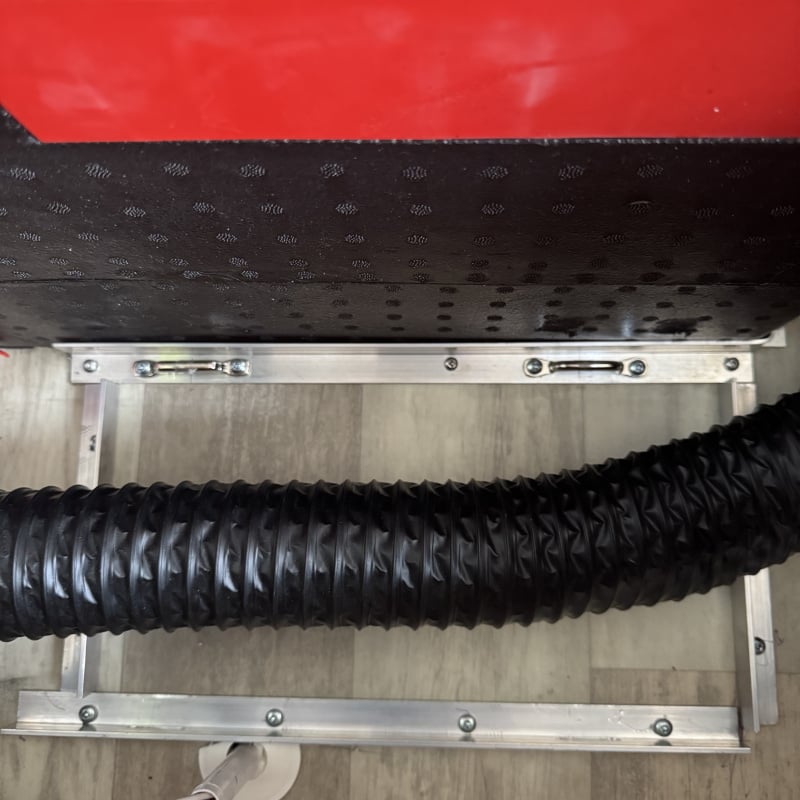
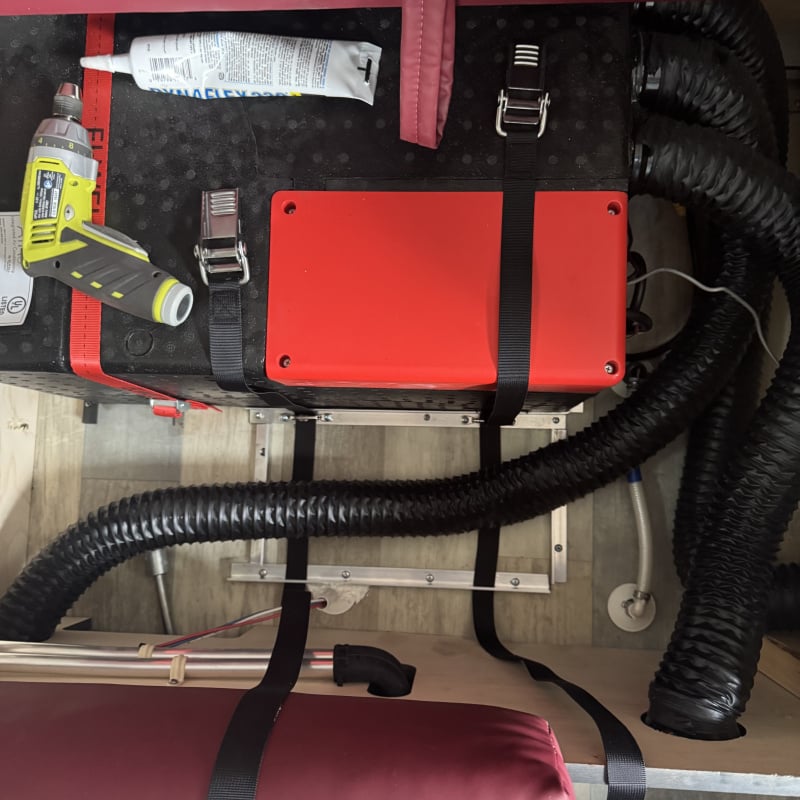
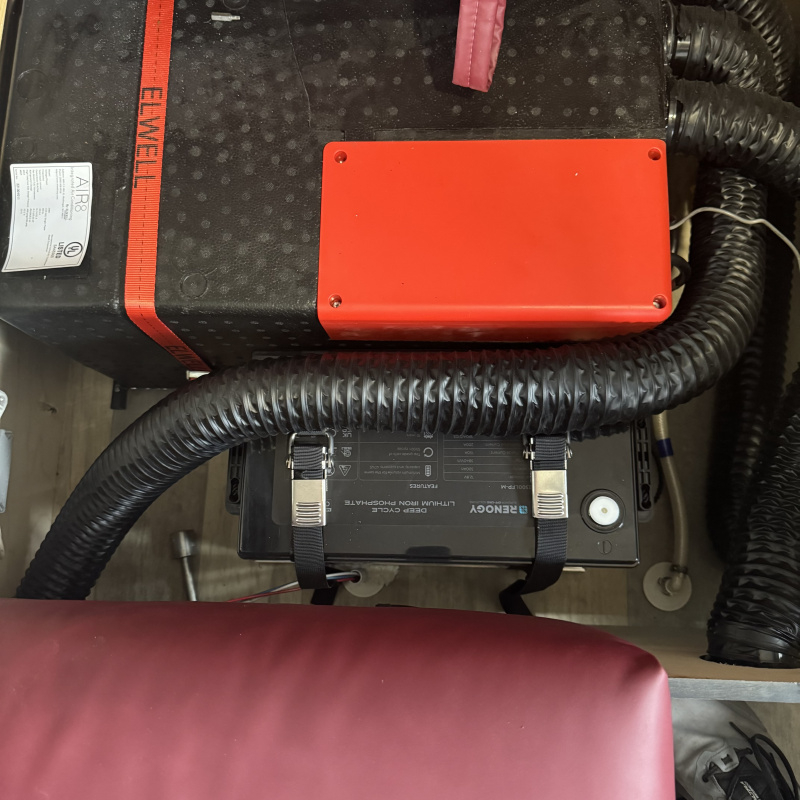
I had to cut part of the gland to get the battery in. I used the "bigger the glob, the better the job" approach to sealing the gland. I don't know what the red, white and blue wires that go into the gland are for. I mounted two 1" strap loops to the existing metal frame for the AC unit and put angle aluminum around the base of the battery. Two Monster Lithium battery straps hold the battery in place, but I think one would have been sufficient.
I also took about 4 feet of wire off the AC power cord for the AC unit. Not sure why NuCamp left it so long. It's enough of a mess without additional wire length.
I plan to mount a Victron 75/15 MPPT controller just forward of the negative battery terminal on the back of the rear bench. I will probably mount the bus bars in there as well if I can make them fit, otherwise they will be placed in the left wheel-well. I will likely leave the existing Victron 75/10 MPPT controller where it is now in the left wheel-well. I am also adding a 300A Victron Smart Shunt with temperature sensor.
Adventure Cats living in the Pacific NW USA
2022 NuCamp T@B 320S Boondock
2023 Volkswagen ID.4 Pro S Plus AWD
2022 NuCamp T@B 320S Boondock
2023 Volkswagen ID.4 Pro S Plus AWD
Comments
-
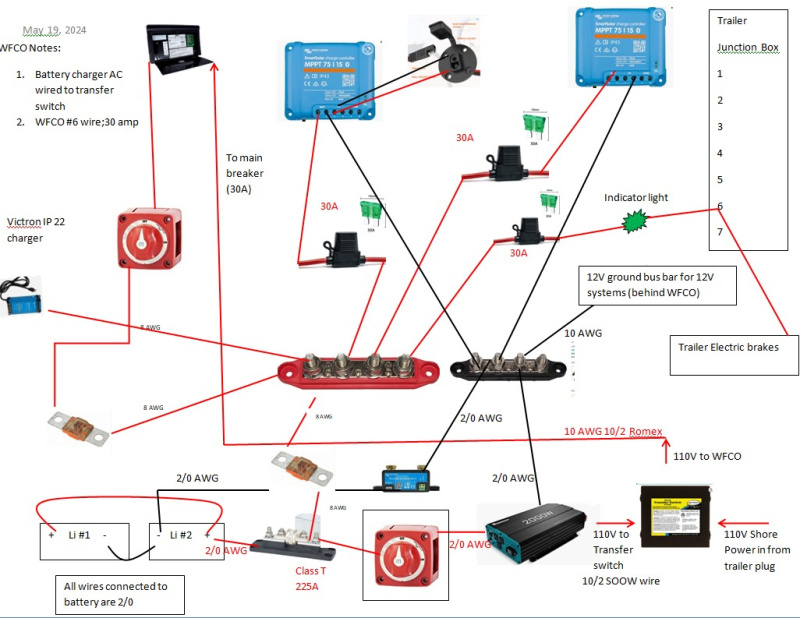
Hi, When I had my '21 320, I moved my batteries inside (same location as you) and a second inside solar controller without cutting any holes in the Tab or fishing wires from inside to outside. All wiring was done inside . Below is a wiring diagram of how it's done. The top part shows the existing wiring. The #6 wire from behind the WFCO is the same wire the runs outside , first to the the trailer junction box, then to the battery switch and then to the battery.
So you can use this very wire, to the battery inside by splicing into it (X on a diagram).
I cut the #6 wire from behind the WFCO and ran it to a bus bar inside (via a switch). Now you have the same battery wire (from the WFCO) that went outside to the battery. From the busbar, you can run it to your inside new battery (do need a switch).
But, an important thing to note is the power for the electrical emergency brakes comes from the outside junction box. So this still needs to be powered. To do this, I connected the downsteam #6 wire (where it was cut behind the WFCO and runs outside) , also to the bus bar. This will then provide power to the trailer junction box (provided the inside switch is on). I added a small indicator light so I can alway see the trailer brakes had power.
I added a new switch inside in order to turn power from the battery OFF/ON like the outside switch since the outside switch no longer is connected to the battery. But the outside switch will have power (via busbar) if you want to use it for something, but I used it for an external solar panel plug.
I added a second solar controller by using the existing wire (now unused) that ran to the battery/switch outside. I put a solar connector on the front tub, but put the solar controller inside near the battery. The ground wire also runs outside so, you can just connect the inside ground to the OEM/existing ground bus bar. It might be full, I blieve I added a second connecting ground bus bar (I also added an inverter at the same time as all this upgrade).
Not sure what yo mean by battery maintainer. If you mean an external charger. This can also be done inside by wiring it to the positive busbar, which goes to the battery. To power the external charger, in my case (Victron IP 22) , I added a new outlet that I could turn off via breaker. The last breaker (usually for the microwave) in the WFCO is a tandem breaker taking up two places. You can split that into two slim breakers (WFCO allows this) and create a breaker for another circuit for a stand alone plug to power a stand alone battery charger inside.
Hope this helps..ask any further questions. I took a very deep dive into my 320 electrical when I had it.
Below is also my final wiring diagram that shows everything, although it added more components (inverter and transfer switch) than you plan to...but it may be helpful.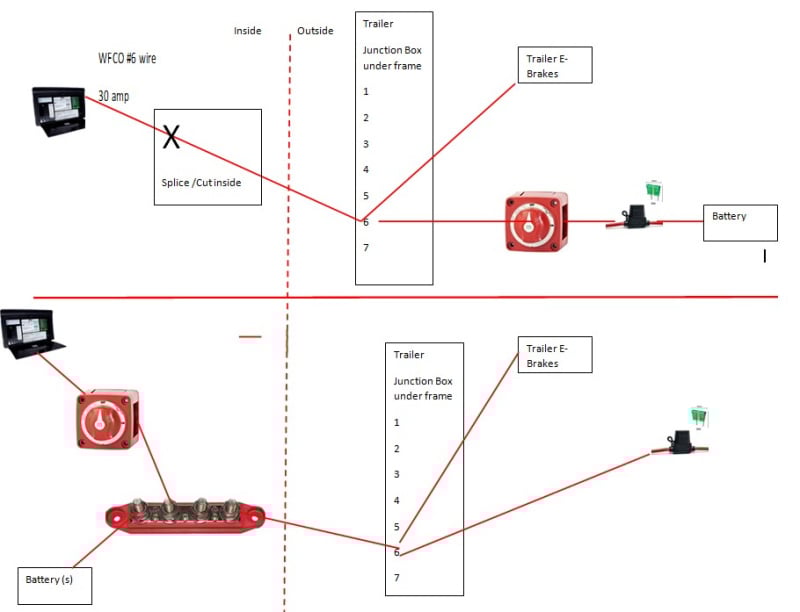
2025 360 CS
2021 TAB 320 BD (w/new owner having fun)
2021 Jeep Grand Cherokee
Southern Maryland -
CatDaddy said:
…[snip]…
As part of this upgrade, I plan to add a second solar panel (120W Renogy Shadow Flux) mounted on the rack and a second MPPT controller mounted near the battery.
…[snip]…
I also took about 4 feet of wire off the AC power cord for the AC unit. Not sure why NuCamp left it so long. It's enough of a mess without additional wire length.
…[snip]…
I mounted a flexible 100W panel to my rack. Fits perfectly. I wrap the MC4>SAE cable around the aluminum bracket, and through the opening at the bottom of the Nautilus compartment.
I also shortened the AC wire on both the Air8 and Alde, and put right angle Leviton 20 Amp plug end, eliminated having to press in the original ones that loosen from vibration, due to all the excess wire.
https://a.co/d/9Zi1cZ1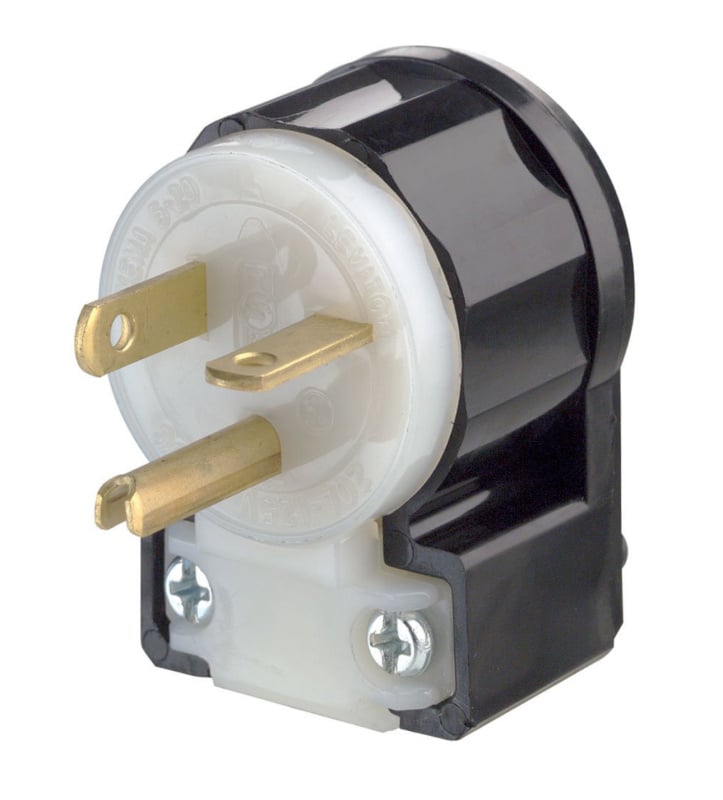
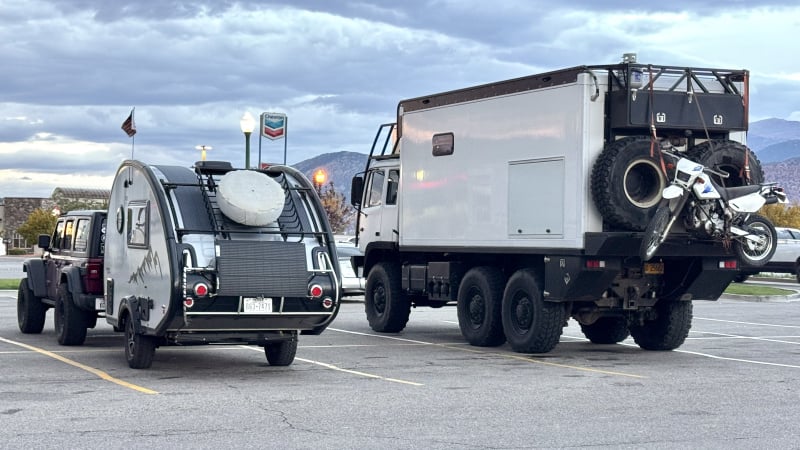
My 2024 T@B 320S BBC is on the left.
 Don Montalvo | Retired Veteran | Full time boondocker
Camper: nuCamp T@B 320S BBC | 12V 2x100Ah LiFePO4 | 600W Solar
Tow Vehicle: Jeep JLU Rubicon | 12V 100Ah LiFePO4 | 200W Solar
https://revkit.com/donmontalvo/ | https://donmontalvo.com -
donmontalvo said:I mounted a flexible 100W panel to my rack. Fits perfectly. I wrap the MC4>SAE cable around the aluminum bracket, and through the opening at the bottom of the Nautilus compartment.
I also shortened the AC wire on both the Air8 and Alde, and put right angle Leviton 20 Amp plug end, eliminated having to press in the original ones that loosen from vibration, due to all the excess wire.The original owner of my 320S BD also ran the wiring for the extra solar panel in through the drain in the Nautilus compartment. I guess that is okay, but he used what is essentially lamp cord to wire in the panel. It was not rated for outdoor use and the UV rays had destroyed the insulation in just two years. It was kinda dangerous. I hope to bring the wires in behind the solar panel and through the license plate opening.I haven't had any issues with the AC or Alde coming unplugged, yet, but I will have a look at the power cord for the Alde. If I can shorten it, I will. Thanks for the suggestion!Adventure Cats living in the Pacific NW USA
2022 NuCamp T@B 320S Boondock
2023 Volkswagen ID.4 Pro S Plus AWD -
Yoshi_TAB said:
I cut the #6 wire from behind the WFCO and ran it to a bus bar inside (via a switch). Now you have the same battery wire (from the WFCO) that went outside to the battery. From the busbar, you can run it to your inside new battery (do need a switch).
But, an important thing to note is the power for the electrical emergency brakes comes from the outside junction box. So this still needs to be powered. To do this, I connected the downsteam #6 wire (where it was cut behind the WFCO and runs outside) , also to the bus bar. This will then provide power to the trailer junction box (provided the inside switch is on). I added a small indicator light so I can alway see the trailer brakes had power.
I added a new switch inside in order to turn power from the battery OFF/ON like the outside switch since the outside switch no longer is connected to the battery. But the outside switch will have power (via busbar) if you want to use it for something, but I used it for an external solar panel plug.I'm not finding the #6 AWG wire that you describe. I will look again tomorrow. In any case, I very specifically want to keep and use the disconnect in the front tub. I store my trailer at a storage place that needs to access the battery disconnect. For that reason I was trying to figure out how to fish a couple of heavy wires from the right-rear compartment where the AC unit is to the tub. I see wires going into the left (driver's side) frame, but I can't find where they emerge.Your diagram only shows one wire. Am I to assume that the return path is through the metal frame? Yikes!The storage facility has provisions to connect a battery maintainer to the battery. I just don't know how people are doing that. I'm currently planning to provide an SAE connector, maybe in the Nautilus compartment to connect the battery maintainer, but I'm open to other ideas.I'm aware of the issue with the battery disconnect disconnecting power to the electric brakes. That seems like a terrible idea. I'm surprised that the regulatory people allow that. If I can eliminate that issue with this mod, I will.Right now, my main problem is finding a way to get heavy wires from the right-rear compartment to the disconnect up front.
Adventure Cats living in the Pacific NW USA
2022 NuCamp T@B 320S Boondock
2023 Volkswagen ID.4 Pro S Plus AWD -
There have been owners who dropped the coroplast cover under the trailer and went into the battery area through the floor.
2017 Outback
Towed by 2014 Touareg TDi -
Hi,
1. Here is a link of someone who cut a hole in their TAB to route a heavy gauge wire. Go to the last part of the post. Although I did not do it that way, I asked a bunch of questions and was provided very good details and photo of how they did it.
Renogy 2000W Inverter Install in T@B 320S - Page 3
2. Front batterty switch Power. If you connect the wire back to the junction box for the electric brakes, the front switch will have power, as the the switch wire runs through the trailer junction box. Here is a link to diagram from the owners section here for a 2017, but my '21 was wired the same way. You can see how it goes
3. Re" #6 Wire; It will be the fuse labeled converter power. Mine was in the 6th slot..I think most of them are the same. This is the wire that goes to the battery .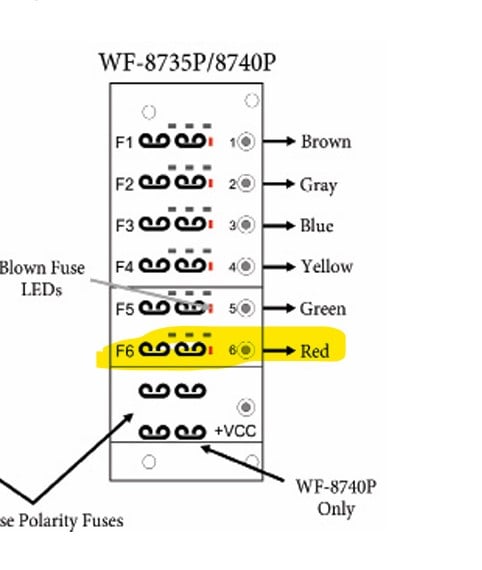
4. Re: emergency brake and ON/OFF switch. Totally agree. A system safety device should never go through a switch the relies on a human to keep on. In the world of hazard analysis failure scenarios, that would not be acceptable. When I did my electrical upgrade, I actually ran the wire directly and not through the switch to by pass having the need to have the switch on (the busbar is always hot from the batteries. The new ON/OFF switch turns power off to the WFCO. The small indicator light is a visual to say the brakes always have power.
5: I'm not sure what "one wire: you are referring to. My diagram does not include any of the OEM ground wires only the new ones i installed for the inverter circuit and solar.2025 360 CS
2021 TAB 320 BD (w/new owner having fun)
2021 Jeep Grand Cherokee
Southern Maryland -
It's it difficult to drop the coroplast cover?pthomas745 said:There have been owners who dropped the coroplast cover under the trailer and went into the battery area through the floor.
Adventure Cats living in the Pacific NW USA
2022 NuCamp T@B 320S Boondock
2023 Volkswagen ID.4 Pro S Plus AWD -
Depending on the year, not too hard. The newer trailers seem to have a more "solid" coroplast (or some sort of panel) under the trailer. The coroplast cover is attached to the frame with a flexible aluminum rail arrangement.If you crawl under the trailer and have a look, you can see the aluminum "rails" attached by screws through the rails, through the plastic, and into the frame.
Towed by 2014 Touareg TDi -
The problem I have found is those attachment screws rust over time and when you try to remove them, their heads break off. Then you have to drill the body of the screw out and put in a new screw. NuCamp would have done well to employ heavier duty screws.2021 400 BD / 2016 VW Touareg / Austin, TX
-
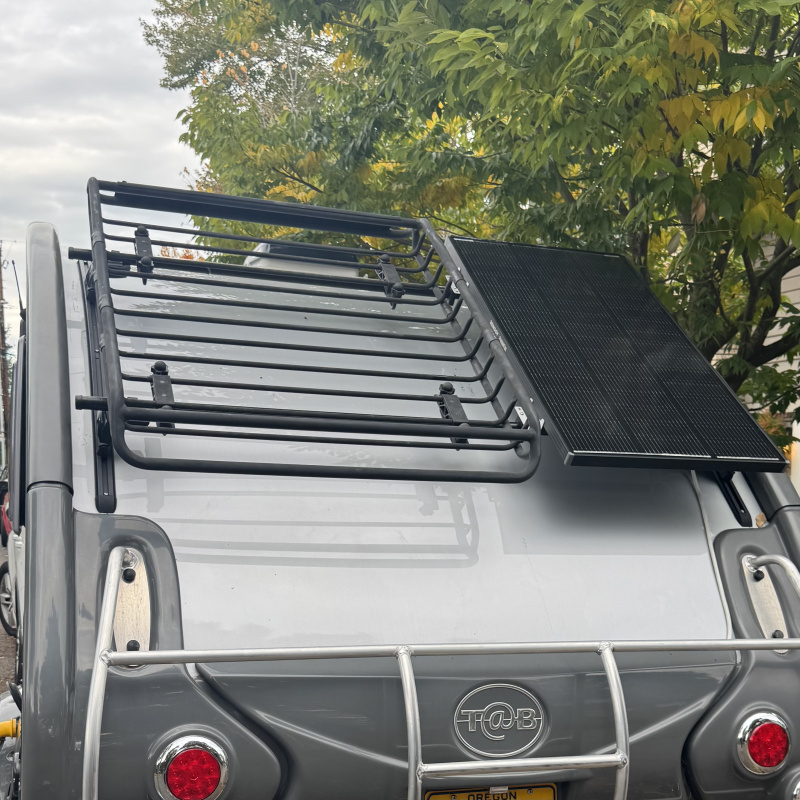
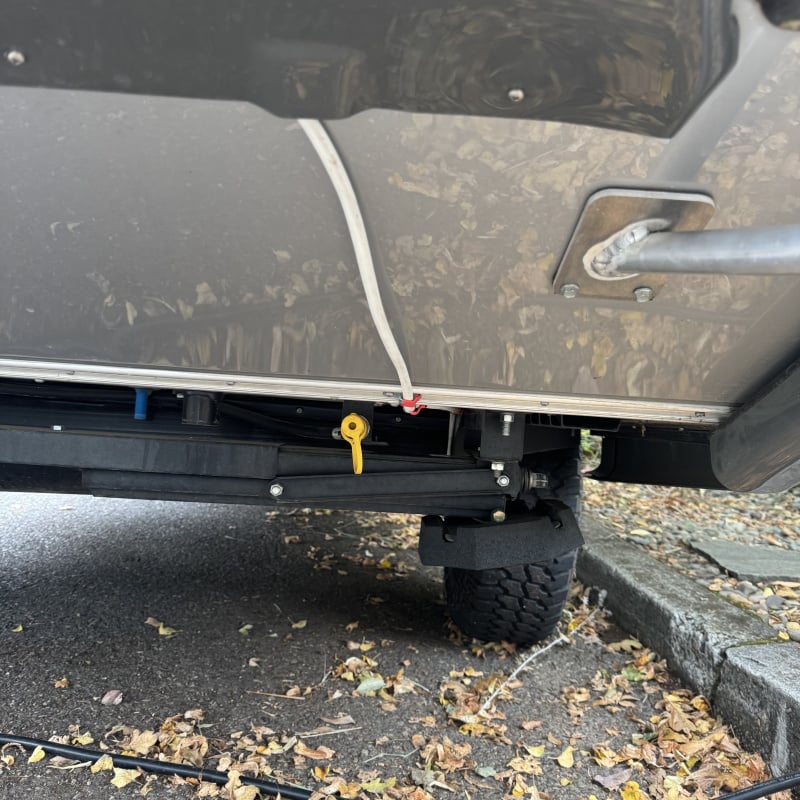
Thanks everybody! I have successfully installed a 300Ah LiFePo4 battery in the passenger-side rear compartment in my 2022 320S Boondock, just forward of the AC unit. I left the battery disconnect switch in the front tub. I also installed a Renogy ShadowFlux 120W solar panel on the rear rack and an associated second Victron MPPT 75/15 charge controller and Victron 300A Smart Shunt. The Renogy 120W panel was only $93 delivered.I fished the wire from the solar panel through the back cowling and ran it up an existing gland from underneath that had red, white and blue wires associated with the fresh water tank level sensor running through it. I repurposed existing screws to hold cable clamps to secure the cable underneath the trailer.The new MPPT controller, terminal block and shut were mounted between the AC unit and the center divider (left to right).For whatever reason, the original MPPT controller ran directly to the batteries in the front tub. I repurposed these two wires in parallel to bring the new battery to the front tub. This eliminated having to find a way to fish wire from the rear to the front tub.I ran a cable from the Nautilus box to the battery for a Nuco Genius charger. That should make the storage place happy.Here's what I learned:
- The quality of NuCamp construction is much lower than I thought before I started the project. I found numerous wire poor crimps, stripped screws, missing screws and shoddy routing of wires. In particular, the access to the Alde reservoir is ridiculous. It's not water-tight and continual removal of wood screws is going to strip out the holes eventually. The top of the access panel isn't even in a groove. They sure made accessing one of the key maintenance items difficult. The stove lid won't even stay open...
- NuCamp has an affection for 30A fuses. Specifically, every fuse outside of the WFCO is 30A. According to the documentation, the WFCO 8735 can deliver 35A of charging current, but it's fused at 30A. That means, if the battery is deeply depleted the WFCO will try sending the full 35A to the battery, causing the fuse to blow.
- The "Battery Disconnect" switch doesn't disconnect the battery from the MPPT or the WFCO. It should really be referred to as the "Load Disconnect" switch because all it does is disconnect the loads from the battery. The WFCO and factory MPPT controller will continue to charge the battery when the "Battery Disconnect" switch is open. I don't know why this is, but since I'm new to RVing, I decided to keep my trailer that way. In my system, the WFCO, and both MPPT controllers are always connected to the battery.
- The factory Sun Flare solar panel kinda sucks. It's possible that my panel is damaged in some way, but the factory 133W panel struggles to even turn on the MPPT controller in cloudy weather, whereas the new Renogy ShadowFlux doesn't have a problem even when it is not in a good alignment with the sun. I actually thought I'd messed up the wiring somehow. I spent hours trying to figure out where the problem was until by luck, the clouds parted and the factory panel got enough light to actually start charging the battery.
- The rear Yakima rack is worthless. I would need a ladder to load anything on it and I'm definitely NOT carrying a ladder. I will probably remove it.
- Finding a clean and neat way to mount the rigid Renogy panel to the Yakima round bars was challenging. I finally found some brackets made for sailboat railing made by Sea-Dog Line (PN 327191-1) to clamp on the round bars. The brackets come in pairs so you only need two packages. I drilled new holes in the Renogy Z mounting brackets to attach them to the round-bar clamps.
- I found a thin gray wire bundled in with a bunch of other wires in the driver's side wheel well compartment that isn't connected to anything. I was unable to figure out what it is for. Does anybody else know anything about it?
- I was hoping to move the spare tire from the tongue to underneath the A-Frame but apparently the larger Boondock tires don't fit there.
- The screws for the lid on the junction box on the A-Frame are 10mm, the only metric fastener I found on the entire trailer.
- Removing the tub was easier than I expected.
- Nearly all of the caulking on my 3.5 year old trailer has failed.
- Victron makes really nice stuff. I am very impressed with how easy it was to add the new components and network them together.
- The "red #6 AWG" wire @Yoshi_TAB talks about is a red #10 AWG wire in my trailer. I didn't have to splice this wire because I kept the disconnect in the tub.
- I am really excited about having usable space in the tub!
- Removing the two lead-acid batteries from the tub and adding the new battery behind the axle, reduced the tongue weight by over 100lbs. That noticeably reduced the sag in the rear of my tow vehicle (2014 VW Touareg TDI).
- I still need to find a small, surface-mount, 10-15A, double-pole breaker to use as a disconnect.
Knowing what I know now, I probably should have mounted a 200W panel and removed the rack. I sized the wiring from the panel to the new MPPT and the new MPPT itself to handle a 200W panel so that would be a relatively easy thing to do. Alternatively, I may buy a solar suitcase and run another plug to the battery. There is space on the new terminal block for that.Before I started this project, I had my eye on upgrading to a Tab 360 Black Canyon. Now, I'm not so sure. If the solar system in the 360 Black Canyon is anything like what I have, I want nothing to do with it.I can post a write-up with photos if there is interest.Thanks to everybody for the help! I am very glad to have this project behind me!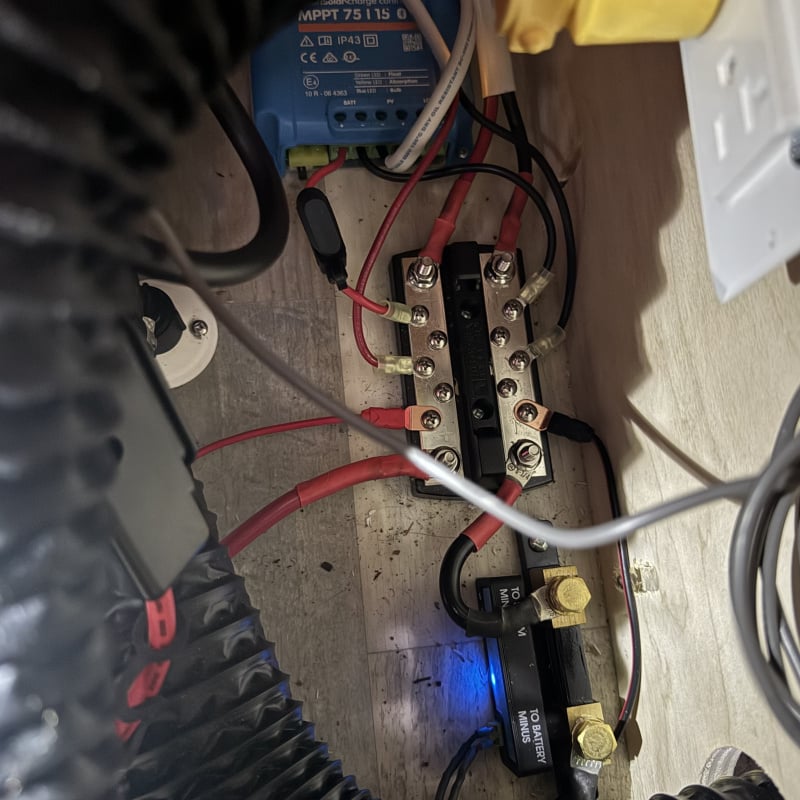
 Adventure Cats living in the Pacific NW USA
2022 NuCamp T@B 320S Boondock
2023 Volkswagen ID.4 Pro S Plus AWD -
Storage inside our 320 is at a premium. It's a popular trend, but moving our batteries from the tongue box has never had any appeal.
-
The primary goals were to nearly triple the energy storage and double the power generation capacities. Freeing up easily accessible storage in the front tub and reducing the tongue weight were welcome side benefits. The space where the battery and electronics went wasn’t very usable for storage due to the plumbing and air ducts that were in the way. The storage in the front tub is much more usable.AnOldUR said:Storage inside our 320 is at a premium. It's a popular trend, but moving our batteries from the tongue box has never had any appeal.Adventure Cats living in the Pacific NW USA
2022 NuCamp T@B 320S Boondock
2023 Volkswagen ID.4 Pro S Plus AWD -
Your reasoning is good and fits your needs well, but for us it didn't make sense. The truck box I put on the tongue has plenty of room for the two 300Ah batteries plus all the other gear that doesn't have to be in the cabin. Even with the 100+ pounds of battery, our tongue weight is well withing the 10% to 15% required for safe towing.
Stockton, New Jersey
2020 nuCamp T@B 320S * Jeep Wrangler
60,865 camping miles through the end of 2025 -
Hi,
Re : #13 Just to clarify for others, it was not a 6 AWG wire vs. 10 AWG. It was the wire in the #6 terminal battery connection in the WFCO (which is a 10 AWG wire) . That is the same wire that goes out ot the battery in the tub. There is no 6 AWG OEM wire in a 320.2025 360 CS
2021 TAB 320 BD (w/new owner having fun)
2021 Jeep Grand Cherokee
Southern Maryland -
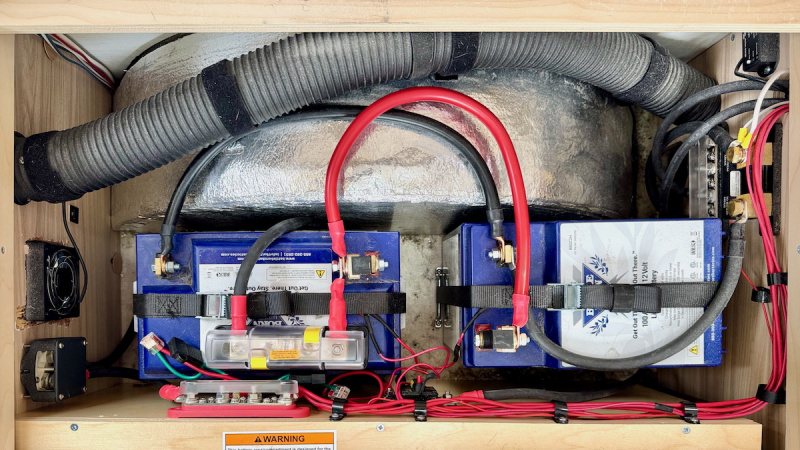
CatDaddy said:Thanks everybody! I have successfully installed a 300Ah LiFePo4 battery in the passenger-side rear compartment in my 2022 320S Boondock, just forward of the AC unit.I'd love to see a picture of your 300Ah LiFePO4 battery installed by the Air8, also if you can provide the make and model? My 2024 320S BBC came with a 100Ah Battle Born battery, I was able to fit a second one in the same compartment. I didn't think I could fit a bigger battery anywhere, but if possible I'd love to see a pic. Here is mine:
 Don Montalvo | Retired Veteran | Full time boondocker
Camper: nuCamp T@B 320S BBC | 12V 2x100Ah LiFePO4 | 600W Solar
Tow Vehicle: Jeep JLU Rubicon | 12V 100Ah LiFePO4 | 200W Solar
https://revkit.com/donmontalvo/ | https://donmontalvo.com -
I installed a Renogy Core Mini 300Ah LiFePo battery. It is not self heated but it has temperature protection. Having it inside the cabin should moderate the temperature range it experiences.donmontalvo said:I'd love to see a picture of your 300Ah LiFePO4 battery installed by the Air8, also if you can provide the make and model? My 2024 320S BBC came with a 100Ah Battle Born battery, I was able to fit a second one and the same compartment. I didn't think I could fit a bigger battery anywhere, but if possible I'd love to see a pic. Here is mine:Here are a two photos. The first one shows the metal frame I made. The second photo shows the battery installed. The new MPPT controller, smart shunt and terminal block are mounted to the right of the AC unit in this photo. I used two Monster Lithium battery straps but one would have sufficed. Note that I had to hack the gland containing red, white and blue wires to get the metal frame to lie flat. The battery is very secure. It isn’t going anywhere. Let me know if you have any questions.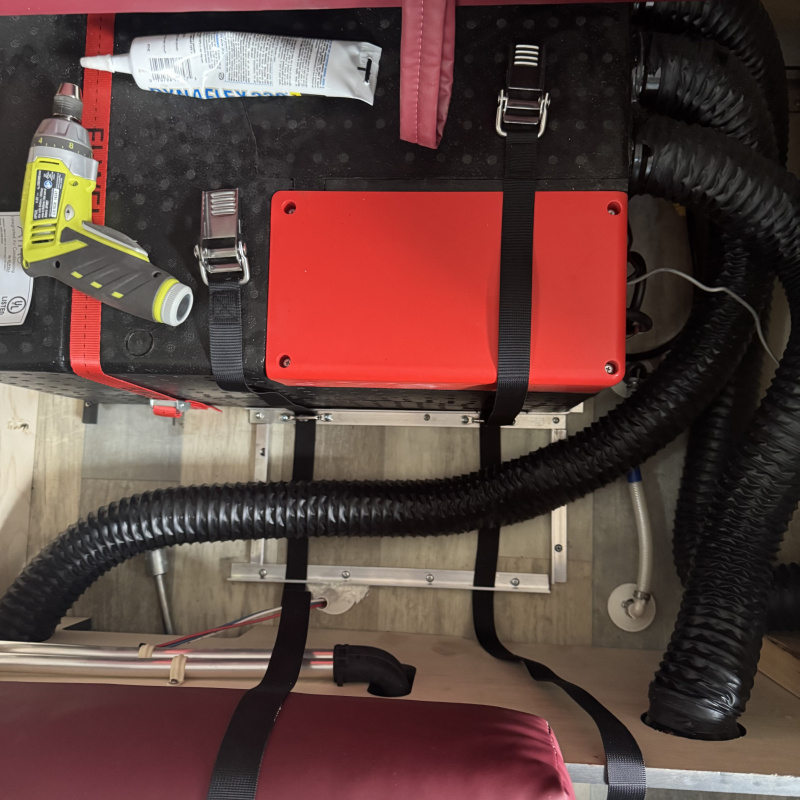
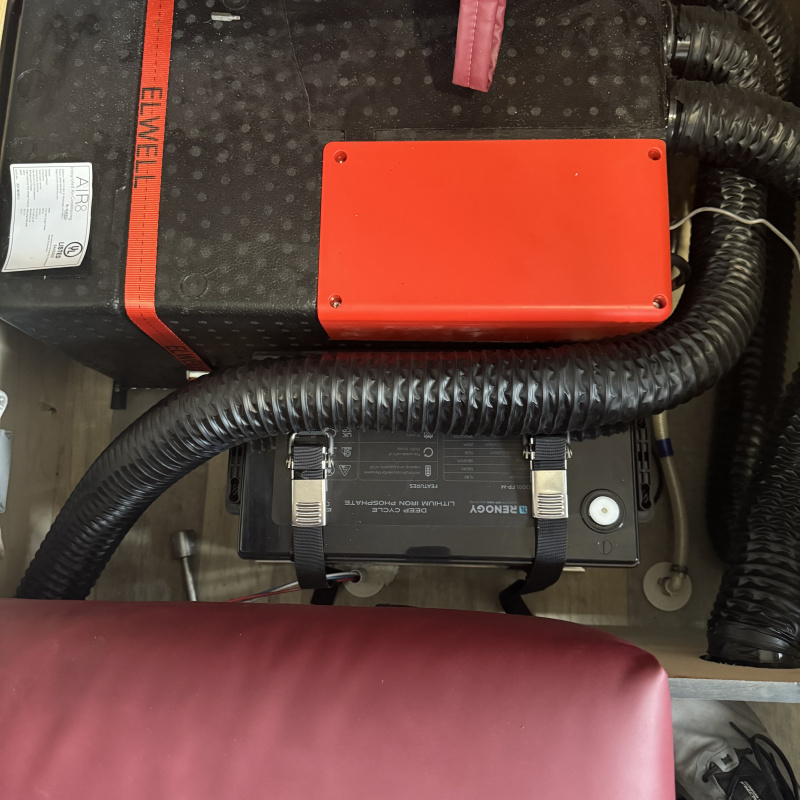 Adventure Cats living in the Pacific NW USA
2022 NuCamp T@B 320S Boondock
2023 Volkswagen ID.4 Pro S Plus AWD -
OK, I am finally contemplating doing this mod myself. (2022 320 CS-S) Three questions.Yoshi_TAB said:Hi, When I had my '21 320, I moved my batteries inside (same location as you) and a second inside solar controller without cutting any holes in the Tab or fishing wires from inside to outside. All wiring was done inside . Below is a wiring diagram of how it's done. The top part shows the existing wiring. The #6 wire from behind the WFCO is the same wire the runs outside , first to the the trailer junction box, then to the battery switch and then to the battery.
So you can use this very wire, to the battery inside by splicing into it (X on a diagram).
I cut the #6 wire from behind the WFCO and ran it to a bus bar inside (via a switch). Now you have the same battery wire (from the WFCO) that went outside to the battery. From the busbar, you can run it to your inside new battery (do need a switch).
But, an important thing to note is the power for the electrical emergency brakes comes from the outside junction box. So this still needs to be powered. To do this, I connected the downsteam #6 wire (where it was cut behind the WFCO and runs outside) , also to the bus bar. This will then provide power to the trailer junction box (provided the inside switch is on). I added a small indicator light so I can alway see the trailer brakes had power.
I added a new switch inside in order to turn power from the battery OFF/ON like the outside switch since the outside switch no longer is connected to the battery. But the outside switch will have power (via busbar) if you want to use it for something, but I used it for an external solar panel plug.
I added a second solar controller by using the existing wire (now unused) that ran to the battery/switch outside. I put a solar connector on the front tub, but put the solar controller inside near the battery. The ground wire also runs outside so, you can just connect the inside ground to the OEM/existing ground bus bar. It might be full, I blieve I added a second connecting ground bus bar (I also added an inverter at the same time as all this upgrade).
Not sure what yo mean by battery maintainer. If you mean an external charger. This can also be done inside by wiring it to the positive busbar, which goes to the battery. To power the external charger, in my case (Victron IP 22) , I added a new outlet that I could turn off via breaker. The last breaker (usually for the microwave) in the WFCO is a tandem breaker taking up two places. You can split that into two slim breakers (WFCO allows this) and create a breaker for another circuit for a stand alone plug to power a stand alone battery charger inside.
Hope this helps..ask any further questions. I took a very deep dive into my 320 electrical when I had it.
Below is also my final wiring diagram that shows everything, although it added more components (inverter and transfer switch) than you plan to...but it may be helpful.
1. I have an existing factory solar. How would I bring those connections to the inside battery. (From the controller?) Disconnecting the wires from the controller that go outside?
2. Where does the ground wire (negative) come from to the inside battery?
3. Do I still need another inline 30 Amp fuse? Does it go before or after the Bus Bar?Carol
MOUSE-KE-T@B
2007 Dutchmen T@B Clamshell #2741
2022 nuCamp T@B 320 CS-S
2021 F-150 502A Lariat SuperCrew, 3.5 EcoBoost 4x2
Harvest, AL -
Hi,
#1; Yes, You only have to move the + Battery wire from the solar controller to your (new) busbar or to battery inside (with fuse). You can leave the -(neg) battery. There is no other change to the solar controller . Your is mounted inside under the driver side bed...correct?
#2. There is a negative busbar behind the WFCO with all the other component grounds. You can connect it there. It maybe full. You can add another small ground bar. Just run a wire inside from the battery negative to this bus bar.
#3. Not sure which circuit you are refering to, but probably yes, here was my complete install if that helps. Has more "stuff" but might be helpful.
Ask more questions....the below diagram may or may not make it more confusing.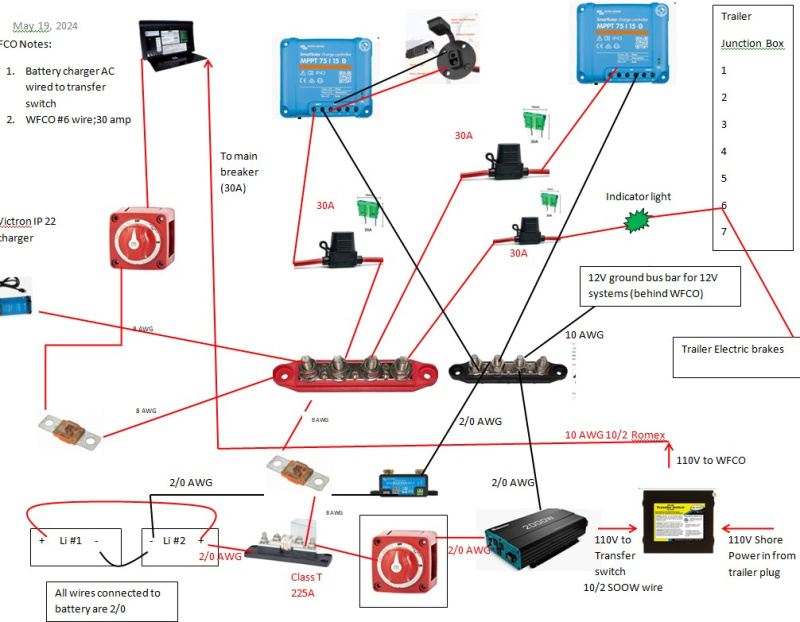
2025 360 CS
2021 TAB 320 BD (w/new owner having fun)
2021 Jeep Grand Cherokee
Southern Maryland -
Yoshi_TAB said:Hi,
#1; Yes, You only have to move the + Battery wire from the solar controller to your (new) busbar or to battery inside (with fuse). You can leave the -(neg) battery. There is no other change to the solar controller . Your is mounted inside under the driver side bed...correct?
Yes it's under the bed next to the shower.
#2. There is a negative busbar behind the WFCO with all the other component grounds. You can connect it there. It maybe full. You can add another small ground bar. Just run a wire inside from the battery negative to this bus bar.
Got it.
#3. Not sure which circuit you are refering to, but probably yes, here was my complete install if that helps. Has more "stuff" but might be helpful.
On your simpler diagram, you had the new inside battery connected to a busbar, then to the cutoff switch, then to the converter. There was no 30 Amp fuse, but it sounds like I need to put one in that row.
Ask more questions....the below diagram may or may not make it more confusing.
Carol
MOUSE-KE-T@B
2007 Dutchmen T@B Clamshell #2741
2022 nuCamp T@B 320 CS-S
2021 F-150 502A Lariat SuperCrew, 3.5 EcoBoost 4x2
Harvest, AL -
@CatDaddy it is RV industry standard to wire solar source directly to the batteries. . . to maintain charging when trailer is not in use. Assumes sun light available.'18 320 S, pitched axle, 3020HE; PNW basedTV: '17 Colorado V6 Z71 4x4, Tow Package, GM Brake Controller
TV: '25 Canyon AT4
Adventures: 58 Nights: 405 Towing Miles 50,180 -
It's also the reason I use a circuit breaker on each side of both my MPPTs. So I can disconnect the solar panels when necessary. Of course fuses are in place for safety.MuttonChops said:@CatDaddy it is RV industry standard to wire solar source directly to the batteries. . . to maintain charging when trailer is not in use. Assumes sun light available.
Don Montalvo | Retired Veteran | Full time boondocker
Camper: nuCamp T@B 320S BBC | 12V 2x100Ah LiFePO4 | 600W Solar
Tow Vehicle: Jeep JLU Rubicon | 12V 100Ah LiFePO4 | 200W Solar
https://revkit.com/donmontalvo/ | https://donmontalvo.com -
OK, I will be doing the simple version of this conversion. Please check my parts list purchase and installation notes to see that I've got it right.
100 Amp Mini LifePo Lithium Battery - May not get this exact one.
https://www.amazon.com/dp/B0FC5C72LV/?coliid=I3AJLQ97GLVF1V&colid=CIQ9IYB65RY0&ref_=list_c_wl_lv_ov_lig_dp_it&th=1
Battery Tie Down Strap
https://www.amazon.com/dp/B0019LZZCM/?coliid=I3LMLKB9AT2UH2&colid=CIQ9IYB65RY0&psc=1&ref_=list_c_wl_lv_ov_lig_dp_it
8 Gauge Wire Kit - 25 foot each of red/black wire, and some ring connectors and shrink wrap
https://www.amazon.com/dp/B0D1FZ76J2/?coliid=I2NSIH64Q5XGNY&colid=CIQ9IYB65RY0&psc=1&ref_=list_c_wl_lv_ov_lig_dp_it
Bus Bar
https://www.amazon.com/dp/B0D2NDXQHN/?coliid=I31OO21I8ZVM3T&colid=CIQ9IYB65RY0&psc=1&ref_=list_c_wl_lv_ov_lig_dp_it
Battery Cutoff Switch
https://www.amazon.com/dp/B07T288VN8/?coliid=IYGOLHSFQKCSB&colid=CIQ9IYB65RY0&psc=1&ref_=list_c_wl_lv_ov_lig_dp_it
Inline Fuse Holders
https://www.amazon.com/dp/B0C9V3QHH3/?coliid=I38KO8ZP4QGGGV&colid=CIQ9IYB65RY0&psc=1&ref_=list_c_wl_lv_ov_lig_dp_it
Lug Crimper Tool
https://www.amazon.com/dp/B09TGNZPC4/?coliid=ILVMHH941HZW7&colid=CIQ9IYB65RY0&psc=1&ref_=list_c_wl_lv_ov_lig_dp_it
I do have a soldering iron and know how to use it to add the inline fuse holders.
In addition to what this picture shows, I will be disconnecting the positive power from my existing solar controller from the outside battery and rerouting with new wire to the positive on the inside battery with an inline fuse.
I will be putting the negative from the inside battery to the existing negative bus bar (or adding an additional bus bar if all slots are full).
I will be adding an inline fuse between the bus bar and the inside battery.
I will be putting a 12V receptacle at the end of the original outside battery cables and mounting to one of my outside front bins. (For portable 12V freezer in the back of my truck, only connected when stopped. I have 110 Power in the back of the truck while driving).
Just to note, I don't need extensive off grid. At the most I will be without power 4-6 hours in my work parking lot, or stopping for meals/attractions/fuel/rest stops. Between the solar, the DC-DC charging in my truck, and overnight shore power, a single 100AH battery meets my needs for my camper fridge and separate 12V freezer.
(The DC-DC charger is mounted in my truck, and I have wires run from the junction box zip tied along my 7-way cable to a dedicated Anderson connector in my truck bumper)
I just want my battery inside so I can put a 2nd propane tank in my front box. I use an outside Mr. Buddy low flow heater attached to my propane quick connect for outside heat, and that actually uses a good bit of gas. It will save me bringing an extra tank in the back of the truck, or pulling to refill more often.
I'm also not too worried about low temperature charging, as I'm a fair weather princess, and live in the Southeast, and the camper is kept in an insulated garage.
For the 2nd propane tank installation, I will be getting:
Duel Tank Regulator
https://www.amazon.com/dp/B0C23R86YL/?coliid=IBAT6YD2TSH82&colid=CIQ9IYB65RY0&psc=1&ref_=list_c_wl_lv_ov_lig_dp_it
Duel Tank Mounting Rack
https://www.amazon.com/dp/B0BTSKBHX2/?coliid=I209RH23T1FEYW&colid=CIQ9IYB65RY0&psc=1&ref_=list_c_wl_lv_ov_lig_dp_it
Thanks!Carol
MOUSE-KE-T@B
2007 Dutchmen T@B Clamshell #2741
2022 nuCamp T@B 320 CS-S
2021 F-150 502A Lariat SuperCrew, 3.5 EcoBoost 4x2
Harvest, AL -
Hi,
One recommendation I would suggest is to buy high quality name brand wire and fuses. Cheap Amazon knockoffs can lead to problems. IMO, don't want to skimp in this area.
Before buying any wire, I would suggest is to get all your components and either mount them where they will go or lay them out to determine the correct length of cable/wire you need. That way, you can buy them professionally crimped with the right size lug on them at the right length. Getting a good crimp is important when it comes to having a good solid connection with only the planned voltage drop. With bad crimps, you can easily get higher resistance which could cause heat build up in wires at the connections.
Goood source of cable is Windy Nation and Battery Cable USA. Windy Nation has an Amazon store front which makes returning cables easy if you did not get the right length wire or required lug size.
Blue Sea, Bussman and Littleton are good name brand fuses.
I would also suggest not to use a soldered joints, but buy some quality butt connectors with heat shrink covering. Getting a solder connection in some tight places will be difficult. Crimping is much easier. You can buy a hand crimp tool. You also buy end connectors with heat shrink if you need them. (if you are using 10 AWG or smaller wire)
Why do you think you need 8 AWG wire? Isn't all the wiring in your trailer 10 AWG? Is anything higher than 30A? That way you can just use the heat shrink connectors. You can just buy a 25' roll of 10 AWG wire (red and black)
A quick search for that battery leads to kind of bad reviews. I would look at some Will Prowse videos and see what he recommends. He recommends a bunch of lower cost LiPhos batteries such as Litime.
I would suggest to wire your solar controller to the positve busbar to minimize connections to the battery terminal.
As an side, this design allows the trailer electric/break away brakes to always have power independant of battery switch position. I added an indicator light so I could see if their was a power issue going to the brakes.
Hopefully someone else will review. Always good to have a second set of eye on electrical changes.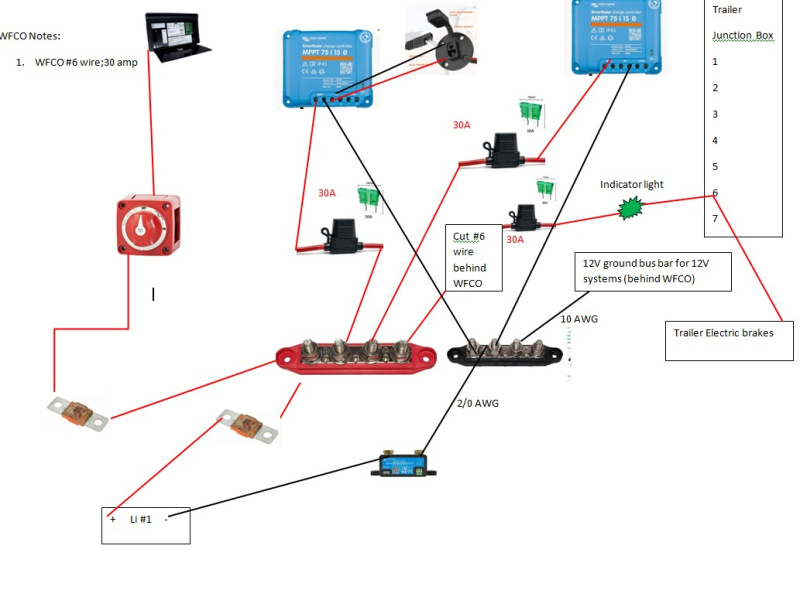
2025 360 CS
2021 TAB 320 BD (w/new owner having fun)
2021 Jeep Grand Cherokee
Southern Maryland -
I'm not sure why I thought I needed 8 ga wire. I will get 10 ga.
Thank you for the recommendations.
As far as the solder joints, I'm envisioning being able to do them offline away from the unit, then putting the completed set in place.
I'll look into the pre-crimped wire posts. Good point. That's kind of why I want to solder the inline fuses, as my hand strength is crap, and I'm not very good at crimps.Carol
MOUSE-KE-T@B
2007 Dutchmen T@B Clamshell #2741
2022 nuCamp T@B 320 CS-S
2021 F-150 502A Lariat SuperCrew, 3.5 EcoBoost 4x2
Harvest, AL -
I agree that circuit breakers on the input side of the MPPT controllers are a good idea. I'm struggling to find small, DC-rated circuit breakers designed for surface mounting. All I'm finding are a host of off-brand, DIN-mounted breakers on places like Amazon. Can you recommend something better?donmontalvo said:It's also the reason I use a circuit breaker on each side of both my MPPTs. So I can disconnect the solar panels when necessary. Of course fuses are in place for safety.Adventure Cats living in the Pacific NW USA
2022 NuCamp T@B 320S Boondock
2023 Volkswagen ID.4 Pro S Plus AWD -
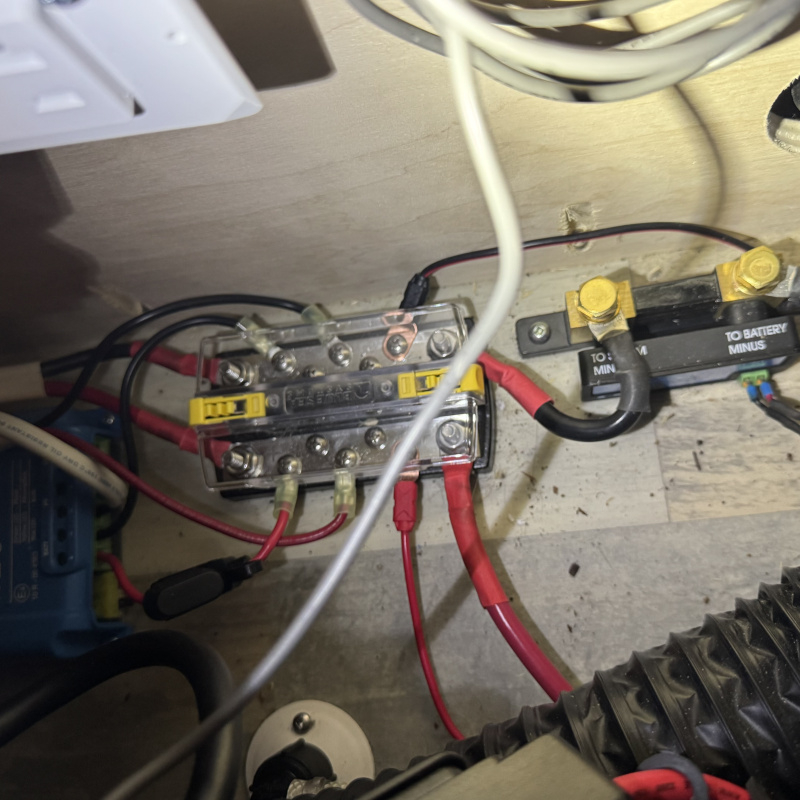
Mouseketab said:OK, I will be doing the simple version of this conversion. Please check my parts list purchase and installation notes to see that I've got it right.I used a Blue Sea Systems PN 2722 DualBus Plus busbar. As the name implies, it has both positive and negative busses. It has 1/4" studs at each end of both busses and five #10 screws for other connections. It is rated for up to 150A. This saves space and it has a plastic cover to keep stuff from dropping onto the terminals and a ridge between the two busses to prevent shorts. As of this writing it is on sale for $24.I connected a Renogy Core Mini 300Ah battery to one end of the busses and the system to the other with the 1/4" studs. The two MPPT controllers and the external charging port to the #10 screws. The negative terminal of the battery connects to the negative bus bar via a 300A Victron Smart Shunt to monitor the battery. See photo below. I used #6 marine wire to connect the battery to the busbar and #8 marine duplex wire to connect the other end of the busbar to the rest of the system. I needed #8 because I plan to add more solar panels.I highly recommend using marine wire instead of wire intended for AC wiring (THN, THHN, etc) because has finer strands and is more flexible. I used marine duplex wire (red and black in one jacket) made by Ankor.I bought the battery from Renogy on a Black Friday sale for about $750 including shipping. Most of the other pieces of my system including the Victron Smart Shunt, MPPT controller, temperature sensor, wire, lugs, fuses and so on from West Marine. They have brick and mortar stores as well as online stores. I bought most of the parts online and returned anything I didn't need to the local brick and mortar store.I highly recommend buying a quality, expensive, crimp tool. Loose crimps are dangerous. I found several loose crimps in my trailer. Apparently, NuCamp doesn't have a quality crimper.Don't forget to put a fuse or other protection device in series with the positive terminal of the battery. My battery has over-current protection, but I don't want to rely on it. I fused my system at 40A but the wiring is good for 50A.If you put in a Smart Shunt, I recommend buying and installing the temperature sensor that goes with it. It connects to the Smart Shunt (blue terminals on the right-side of the photo) and the positive terminal of the battery. This allows you to set temperature limits and monitor the battery temperature remotely.Hope that helps.
 Adventure Cats living in the Pacific NW USA
2022 NuCamp T@B 320S Boondock
2023 Volkswagen ID.4 Pro S Plus AWD -
https://www.amazon.com/Bussmann-CB285-30-Surface-Mount-Circuit-Breakers/dp/B01FWMM260CatDaddy said:
I agree that circuit breakers on the input side of the MPPT controllers are a good idea. I'm struggling to find small, DC-rated circuit breakers designed for surface mounting. All I'm finding are a host of off-brand, DIN-mounted breakers on places like Amazon. Can you recommend something better?donmontalvo said:It's also the reason I use a circuit breaker on each side of both my MPPTs. So I can disconnect the solar panels when necessary. Of course fuses are in place for safety.
Don Montalvo | Retired Veteran | Full time boondocker
Camper: nuCamp T@B 320S BBC | 12V 2x100Ah LiFePO4 | 600W Solar
Tow Vehicle: Jeep JLU Rubicon | 12V 100Ah LiFePO4 | 200W Solar
https://revkit.com/donmontalvo/ | https://donmontalvo.com -
Thanks for that! I did find those when I was looking. West Marine sells them, but I was really looking for a double-pole breaker so the panels are truly disconnected, not just not providing power. I don't know how things are done in the RV world but in the solar world, some jurisdictions require double-pole disconnects. The only double-pole, DC-rated, surface mount breakers I found were off-brand DIN-rail mounted breakers. That would work, but they're not ideal.donmontalvo said:
Adventure Cats living in the Pacific NW USA
2022 NuCamp T@B 320S Boondock
2023 Volkswagen ID.4 Pro S Plus AWD


Categories
- All Categories
- 10 Cirrus Truck Campers
- 118 Dutchman and Vintage TaB Archives
- 3 Forum Rules
- 3 nüCamp & Forum Contacts
- 950 Air Conditioning & Refrigeration
- 2.6K Battery/Electrical & Solar
- 1.2K Camping & Travel
- 142 Events & News
- 219 Factory Comments
- 18 "FOR SALE" - New/Used Trailers
- 15 “FOR SALE" - Camping & Trailer Gear
- 2.4K Heating/Plumbing & Winterizing
- 136 Help - Computer & System
- 916 Introductions
- 407 Looking to purchase a trailer?
- 2.1K Modifications & Upgrades
- 1.4K Products and Accessories
- 402 Service/Maintenance & Recall Notices
- 37 Solo Travelers Hints & Tips
- 1 T@G Forum
- 72 Teardrop Groups & Links
- 77 Testimonials
- 914 Tips & Tricks
- 1.5K Trailer & Towing
- 27 Owners Manuals/PDF Files/Videos & Resources
- 62 üCamp Rally - News & Information