100Ah > 320Ah lithium upgrade

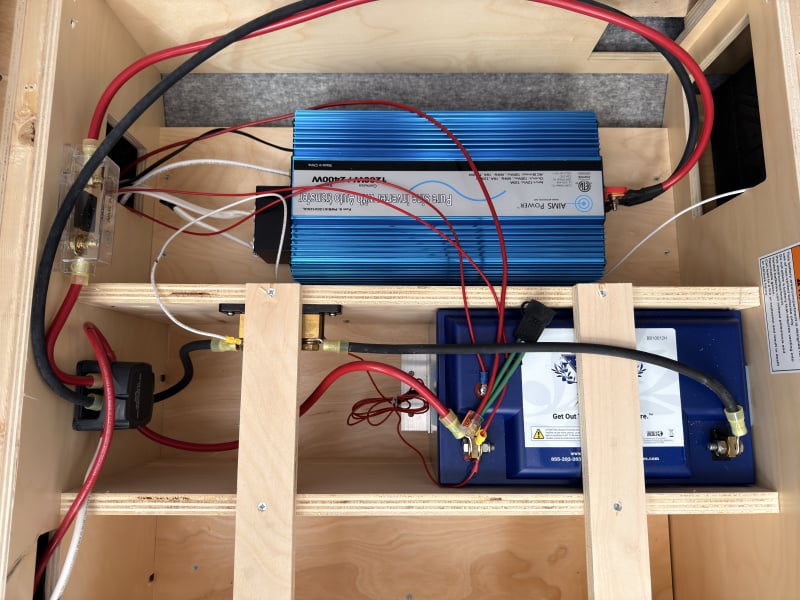
Hi friends, I have a 2024 400 BD, stock with one 100Ah Battleborn battery and 1200W inverter, 310W solar panel on the roof. In the interests of boondocking for longer in shady northeast sites (running the fridge off battery, AC only when electric hookup is available), I’m thinking of replacing the standard single Battleborn with one higher-capacity battery. I realize there are multiple ways to achieve my goal (suitcase solar being one), but I’m thinking a one-for-one battery swap is the simplest and cleanest. I’ve got limited time for a “project” so I’m here wanting to check my impression that swapping in a new battery will be a straightforward affair!
In other words, is it basically a drop-in upgrade, or am I missing something?
What *think* I know:
- A new battery (e.g. 320 LiTime mini) will be larger than the Battleborn, so I’ll have to make sure it fits, adjust the wood braces, and maybe strap it in. Seems easy enough.
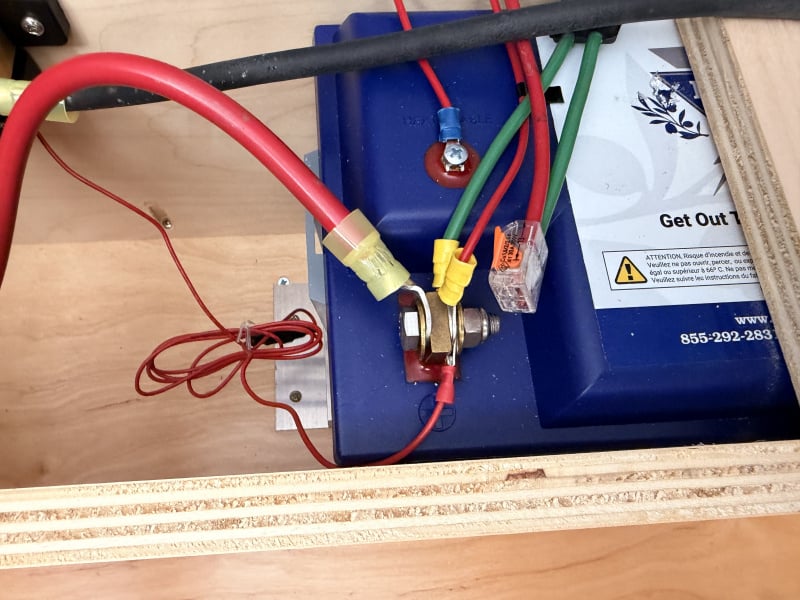
- I’ll have to cap or tape off the lead to the battery heater switch.
- I’m not starting from an AGM battery, so my Victron solar controller should work fine, but I should make sure the voltage set points are correct for the new battery
- There’s a fork-looking connector on the bottommost little red wire that I should replace with a ring connector
What I’m not sure about:
- Assuming the same wires reach the new posts, it looks like the diameter of the screw-on terminals for the LiTime (for instance) is slightly smaller than that of the Battleborn (5/16 vs 3/8). Does this matter, if all of the ring terminals of the cables are screwed in nice and tight and making good contact with each other? It seems like some folks add busses to make everything neat and tidy, but can I get away with just moving over the same wires?
- Because I am not upgrading the inverter, just increasing the Ah of the battery, do I need to think about or upgrade the Gloso battery circuit breaker?
- With the Victron, other than punching in the new Ah of the battery, do I have to do anything else? As far as I understand it, the idea is that the SmartShunt detects when the battery is fully charged, and then tracks everything coming out of the battery from that known point in order to determine remaining capacity.
Comments
-
It's pretty much a drop-in as you described. If you have the tools to crimp a ring terminal onto the fat wires do it but it's not super critical. Personally I'd get a battery with a bluetooth BMS which tends to know more about the battery than the victron battery monitor.1
-
Beside configuring both solar controller and shunt to the new battery specs, the only other thing that I would do is to fully charge the new LiFePO4 with a compatible charger before installing and then set your shunt to the new battery size and synchronize to 100% state of charge.
Stockton, New Jersey
2020 nuCamp T@B 320S * Jeep Wrangler
60,865 camping miles through the end of 20250 -
I did the same in our Cirrus 620, but with the LiTime 230ah bluetooth version, as that's the largest that will fit. I second Grumpy_G, I feel the bluetooth version is critical when having charging issues, and just nice to be able to see the state of charge. Our battery stopped charging from DC sources, so just completed a warranty swap, the bluetooth was very handy when troubleshooting with tech support. We just have 210 watts of solar, but rarely drop the battery below 70%.2015 Max S Outback | 2010 Xterra -- Retired
2022 Ford F350 Tremor | 2022 Cirrus 6200 -
Disconnect these two red wires (to and from the switch in the cubby) to safely disable the heater switch.
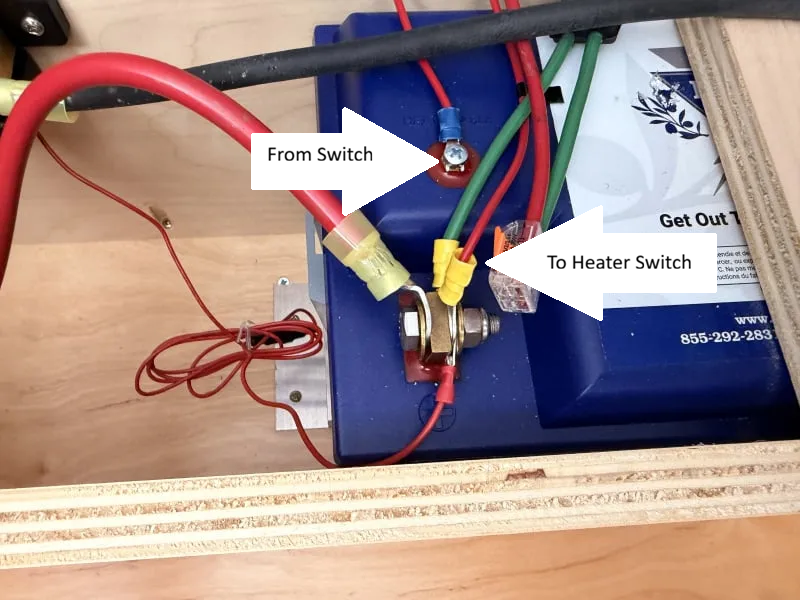
The switch will not have power at that point. You may want to keep the wiring in place in case you come up with an ingenious use for the switch in the cubby later on.'Racing the Wind and Chasing the Sun'
In a 2023 T@B 400 (former T@B 320 owners)
Relentlessly Pursuing a Silverado EV
Homeport - Virginia Beach, VA
2 -
Thanks all! Bluetooth sounds like a no-brainer even if it makes the Smartshunt a bit redundant.@RTWCTS thanks for the diagram. And you’re right … the toggle switch next to the bed will now be begging for a purpose! That’s going to keep me up at night figuring out what to connect it to, I need to call up Q from the Bond movies for an ingenious gadget 🤣
@AnOldUR how important do you think it is to fully charge before installing? I’d be buying a charger just for that, looks like they run $80-100. Happy to spend it for safety or for the health of the battery, but I’d probably save the money if it’s mainly the convenience factor. If the new batt has bluetooth to check the charge level, any harm in letting it charge slowly from the solar, and waiting to synchronize the smartshunt until the onboard monitoring is reading 100%?0 -
I just did the same upgrade (314ah swap out). Battery came half full and I charged it with the WFCO charger (8735 in Lithium Mode). Took about 15 hr to charge and balance, and eventually trip the Victron Smartshunt sync to 100% SoC. Not sure why you would need a different charger.1
-
@benpc
I'm not the best person to comment since it sounds like you'll be going with something with Bluetooth. I went without it for my 300Ah batteries. What I read at the time was that it was not that accurate, but the technology has advanced to where it would now be more beneficial.
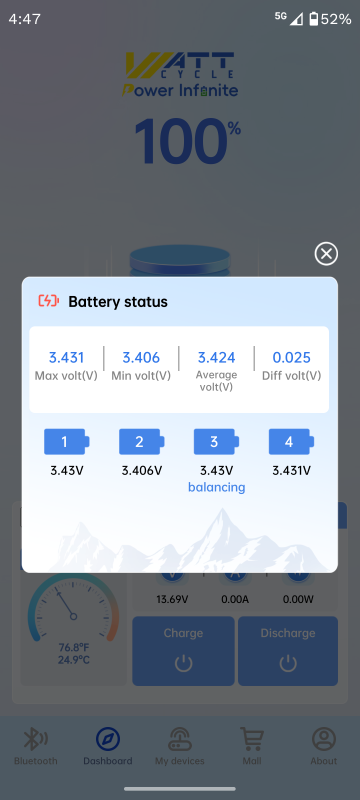
Cell balancing doesn't happen until the battery has gone from bulk to the absorption phase of charging and a level of charge voltage is maintained for a minimum amount of time. It's something that's BMS controlled and can be different depending on the manufacturer. Solar or even you WFCO may not always meet that time requirement. You could potentially drop out of absorption into float too soon. But sense you will be going with Bluetooth, you should be able to monitor the variation in cell voltage.
I have the older WFCO converter that's not lithium compatible. Rather than replace the converter, I mounted and hardwired a Victron lithium charger near my batteries. Very rarely gets used since solar tops them off. A couple of times a year I'll plug it in to be sure the cells are balanced. A standalone charger is probably not something you need to worry about.Stockton, New Jersey
2020 nuCamp T@B 320S * Jeep Wrangler
60,865 camping miles through the end of 20250 -
Ah! It’s because I failed to say that I store my Tab offsite where it doesn’t have access to shore power.Gomers2 said:I just did the same upgrade (314ah swap out). Battery came half full and I charged it with the WFCO charger (8735 in Lithium Mode). Took about 15 hr to charge and balance, and eventually trip the Victron Smartshunt sync to 100% SoC. Not sure why you would need a different charger.0 -
Well that makes sense! I guess you can leave it in the bright Sun and I bet you get a full charge. I will say as a side note on this first trip with the 300 plus ah battery that my "charge anxiety" is really low. So far seems like a good choice to upgrade.
 0
0 -
This new wave of larger capacity, small footprint LiFePO4's are amazing. Makes me wonder what they'll come up with next. Keeping up with the Joneses is a real challenge.Gomers2 said:I will say as a side note on this first trip with the 300 plus ah battery that my "charge anxiety" is really low.Stockton, New Jersey
2020 nuCamp T@B 320S * Jeep Wrangler
60,865 camping miles through the end of 20250 -
Dont worry , you have plenty of room to fit ONE 320ah mini LiFePO4 in the standard 400 battery compartment !
Go big or go home seems to a common theme here , lol .
You will want more battery AH , and a 3000w inverter /charger soon as well . Just some advance warning !
Its nice to be able to control the whole RV on batteries alone if needed . Running the AC and Microwave off batteries alone is a nice option . We find it comes in handy for overnight stops on the way to our destination (Cracker Barrel , Harvest Host, etc) .
We have 900ah+ , 3000w inverter charger and 620w of solar on the roof . I think we are tapped out for now !
I will vote for the no Bluetooth option on the batteries . Keep the batteries simple , and use your shunt for monitoring the battery status . WIll prowse has had lots of bad test results specifically when testing the Bluetooth enabled batteries , vs the exact same Non-bluetooth batteries . The Bluetooth enabled battery BMS seems to be troublesome from what I have seen .
Good luck on the install !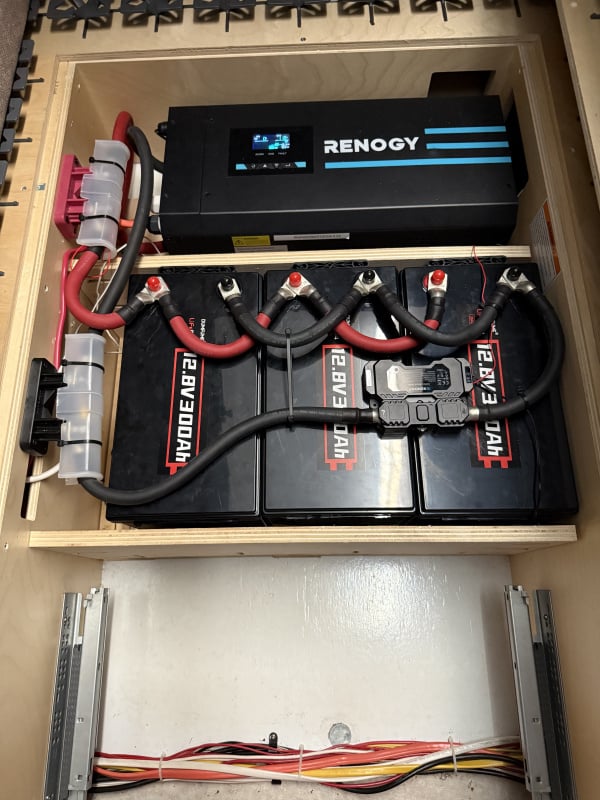 2023 Ford F150 Sport 3.5 Ecoboost
2024 NuCamp T@B 400 BD, Charcoal / White - 900AH LifePO4 , 620W Solar
2016 Ford Transit 350 XLT - Adventure / Travel Van / 320s interior !
2019 NuCamp T@B 320s Grey / Black - SOLD
2 -
I will vote for the no Bluetooth option on the batteries . Keep the batteries simple , and use your shunt for monitoring the battery status .I don't disagree @B0atguy, but they were sold out of non-BT models when I needed one. But now that I have the BT I'm kind of glad I do, it's nice to have a 'second opinion' on the SoC if needed. Plus the BT reports cell balance status, and the app interface offers BMS diagnostics (so far not needed). I still feel the Smartshunt is the more accurate way to determine power in/out.2
-
AnOldUR said:HI! My name is Charles, and I’m a lithium fanatic. It’s been 2 years since I bought my last battery.
Charles & Judy, Santa Cruz, CA
2018 T@B 320 CS-S; Alde 3020; 4 cyl 2020 Subaru Outback Onyx XT3 -
Me too! I have 3 100a Renogy LFP battery in my 2018 400. I keep thinking that 2 of the LiTime 360ah batteries would fit nicely in that slot... I am waiting for self heating ones to be available. In the northeast, big battery rules if you are doing any extended trips, really nice to have lots of extra juice. But.... my batteries are basically new and they work fine.ckjs said:
The one thing that would push me is if I replaced the Cool cat with one of the new 12v ACs. We don't have an inverter and don't really need one, but it sure would be nice to have AC off-grid for sleeping at night. Have to do some significant wiring upgrades to make that work, someday maybe.2019 Honda Ridgeline RTL TV
2018 T@B 400, 300Ah Renogy LiFePo batteries, 350W Renogy rooftop solar
Poughquag, NY0 -
@tphaggerty
I justified the upgrade by using the old batteries for a home built power station. Amazingly the new batteries fit fine in the same location with only a mod to the battery boxes. My wife bought into the upgrade since she likes the freezer in the back of our tow vehicle.
.https://tab-rv.vanillacommunity.com/discussion/20295/power-station-build#latest
That box could have handled a third battery. Something to think about.
Stockton, New Jersey
2020 nuCamp T@B 320S * Jeep Wrangler
60,865 camping miles through the end of 20251





Categories
- All Categories
- 12 Cirrus Truck Campers
- 128 Dutchman and Vintage TaB Archives
- 3 Forum Rules
- 3 nüCamp & Forum Contacts
- 969 Air Conditioning & Refrigeration
- 2.7K Battery/Electrical & Solar
- 1.2K Camping & Travel
- 145 Events & News
- 220 Factory Comments
- 27 "FOR SALE" - New/Used Trailers
- 15 “FOR SALE" - Camping & Trailer Gear
- 2.4K Heating/Plumbing & Winterizing
- 138 Help - Computer & System
- 925 Introductions
- 408 Looking to purchase a trailer?
- 2.2K Modifications & Upgrades
- 1.4K Products and Accessories
- 423 Service/Maintenance & Recall Notices
- 37 Solo Travelers Hints & Tips
- 1 T@G Forum
- 78 Teardrop Groups & Links
- 78 Testimonials
- 922 Tips & Tricks
- 1.5K Trailer & Towing
- 27 Owners Manuals/PDF Files/Videos & Resources
- 56 üCamp Rally - News & Information