What is the baseline power draw, and how can it be reduced?

JHornby
Member Posts: 19
I have a 2021 T@B 320S. I notice when I have "everything turned off" (no lights, no refrigerator, no Alde heating, no TV monitor on, etc.) so long as the master battery connect is on, there is still a drain on my batteries. I am guessing it is about 1 to 1.5 amps based on how fast the batteries are discharging. When boondocking, if there is effectively no solar, this can drain all my battery capacity in a few days or so. Other than disconnecting the battery connect switch, is there something I am missing that I can still turn off to minimize this drain? Is this estimate of baseline power draw about right? Thanks.
0
Comments
-
We have a slightly older 320S, so there will be differences, but our parasitic drain is in the same range as yours. Other owners will surely give recommendation on devices that can be turned off or fuses pulled, but my opinion is that these are mostly convenience things that I'd rather have available. My suggestion is to upgrade your battery capacity to match both your parasitic and camping usage.
Stockton, New Jersey
2020 nuCamp T@B 320S * Jeep Wrangler
60,865 camping miles through the end of 20251 -
Thanks for the confirmation around what I have been thinking. We actually have 200 AmpHours of capacity via two lithium batteries, so normally that has been enough if the trip is less than 5 or 6 days even with just occasional solar. With good solar they don't get drained at all. We normally sleep in the towing truck, so I'm thinking that in many cases I can just disconnect the master switch when not using the camper as long as we are not needing to run the refrigerator. We just got back from a week in Mammoth Hot Springs in Yellowstone and had been counting on just using the fridge as an "ice box" with bottles of frozen water to keep things cool, but it rained all week and never got cold enough to even do that! And of course almost no solar the entire week! Crazy stuff. I think my solution is turn off the switch if necessary.0
-
The baseline power draw on my 2020 T@B 400 has been reduced to 0.15 amps according to my Victron shunt.The stereo used to draw power even when it was off. After installing a switch on the power supply line to the stereo, that parasitic draw was reduced to zero. Before I completely removed the television, it also had a parasitic draw. Installing this inline switch enabled me to reduce that draw to zero as well:
https://www.amazon.com/dp/B01D66D9PMI believe the remaining 0.15 amps is being consumed by the two propane / carbon monoxide detectors connected to the battery. The propane fridge also has a tiny 12V draw.2020 T@B 400 Boondock Lite.
2020 Chevrolet Colorado ZR2
with the 2.8 litre 4-cylinder Duramax diesel.
0 -
If you have installed solar, the Victron app will show you the "parasitic drain". With everything "off", you will be able to see the negative values for "current" and "watts" and have a specific value.In my 2017, the "current" value from my Victron shunt, with the battery switch on and everything I can turn off is off, my "current" is a -.24 of an amp, or about 3 watts. So, about 6 amp hours per 24 hours.Back in the "old days" when the campers were made of iron and we only had 40 amp hours of "usable" power from our 80 amp hour lead acid batteries, this was a "lot" of parasitic drain.So, have a look at your Victron devices (if you have them) and you can get a pretty big idea of your "drain".With 200 amp hours of lithium, and a 6 amp hour a day drain.....your battery could probably last a month before reaching 180 amp hours from that setup.What fridge do you have? The two way fridge's power use is pretty well established at "around" 25-35 amp hours per 24 hours. As you say, that gives you several days of fridge usage with "occasional" solar. Even if you just replaced half of that 25-35 amp hour fridge usage, your 200 amp hour lithiums should be still in a decent state of charge for even more than 5-6 days.Not a bad strategy to turn the fridge off overnight if you need to save power.So: what fridge do you have? Do you have a Victron shunt? If you can show us a photo of your Victron solar controller status page, we can help you decode the numbers you see with the "battery switch on and everything off".
2017 Outback
Towed by 2014 Touareg TDi0 -
I have the newer fridge that only runs on electric. I don't think I have a shunt. (Not really great at this electricity stuff.) I have a victron app that can see whatever the NuCamp installed Solar Controller puts out, which I mostly use to see how many amps are coming in off solar, but when it comes to figuring out the state of charge of the batteries, I just push some button on the Lion Safari batteries that has some sort of idiot lights on top of them that shows state of charge wherein 5 lights - full charge and 0 lit up would be zero, and there are 5 lights total on each battery. So if you get down to say 1 or 2 lit up on each battery, you are in danger of running out of power. I am attaching a snapshot of the app output after I turned off the electric heat I have running off shore power in my garage right now to dry the cabin out after our last trip. Obviously there is no solar input because the 320S is inside the closed garage.0
-
The way the solar controller is installed in the T@b (and pretty much all RVs) is that it only connects the solar panel and the battery, the load terminals are not connected. The loads (lights, fridge, TV etc.) connect directly to the battery (via the fuses) so the solar controller is in the dark (see what I did there ?
 ) about how much current flows out of the battery. Hence the load output is always zero and it doesn't help with troubleshooting. Depending on the exact model of battery it might have bluetooth monitoring which can give you a pretty good reading of actual current draw. As for a baseline current draw that depends a bit on what is installed in the trailer. My 2015 "idles" just shy of 0.3 A with TV, Radio in standby, CO/propane detector, a simple battery monitor and the "night light" in the bathroom. The solar charge controller consumes a little power from the battery when the solar panels do not work.0
 -
That makes sense. The batteries I have are pretty good, but just a bit too old for the direct monitoring via the bluetooth app that comes with the newer ones. All I really have are the idiot lights, but that's ok. I somehow estimated that the refrigerator could draw up to 1.8 amps, which over a few days can wipe out a lot of my 200 amp-hour capacity if not replenished in some way. Normally not an issue, but I think just not using the fridge if I can avoid it and shutting down the who master switch are the keys to my plan of attack now if there is not enough solar. If I try to rewire a bunch of stuff or switch out the Jenson and so on I'll end up screwing it all up and then I'll really be in a bind. Thanks again for the tips.0
-
Some more sources of phantom power draw including Alde and 2cd solar controller:
https://tab-rv.vanillacommunity.com/discussion/18242/alde-phantom-power-draw-0-11-amps-or-18-4a-week#latest
2021 T@B 320S Boondock/ 2012 Tacoma 4 cylinder truck / 2023 Tacoma 6 cyl. truck0 -
If you have a Victron controller, that monitor is lightyears better than any of the bluetooth "monitors" in the batteries, especially if your Lion batteries are "old" as you say. The way that lithium battery voltages "drop" make any "blinky light" display or even various voltage readings very misleading.The best investment to make to sort this out would be a Victron shunt. This would simply remove any question about "is 13.2 volts 70 percent of capacity or 30 percent capacity" of my lithium battery.The shunt will give you much more and better information about exactly where your batteries are.The next thing we should look at is the setup of your Victron solar controller. If you are not very familiar with the workings and readouts of the Victron devices, we should have a look at them with you and make sure your solar setup is correctly set up for charging a lithium battery. Show us the setup page.Towed by 2014 Touareg TDi1
-
If you do a lot of camping without shore power, I recommend that you consider installing the Victron SmartShunt. It measures all power going in/out of your battery, removing the guesswork. I have an older Lion Energy battery with the idiot lights and they aren't really that useful. If your battery is in the tub at the front of the trailer, it would probably be better to get the IP65 (more waterproof) version. The 300A version of either shunt is fine for a T@B.JHornby said:I have the newer fridge that only runs on electric. I don't think I have a shunt. (Not really great at this electricity stuff.) I have a victron app that can see whatever the NuCamp installed Solar Controller puts out, which I mostly use to see how many amps are coming in off solar, but when it comes to figuring out the state of charge of the batteries, I just push some button on the Lion Safari batteries that has some sort of idiot lights on top of them that shows state of charge wherein 5 lights - full charge and 0 lit up would be zero, and there are 5 lights total on each battery. So if you get down to say 1 or 2 lit up on each battery, you are in danger of running out of power. I am attaching a snapshot of the app output after I turned off the electric heat I have running off shore power in my garage right now to dry the cabin out after our last trip. Obviously there is no solar input because the 320S is inside the closed garage.(Links included for information, only. I'm not necessarily suggesting purchasing from Amazon)More information here: https://www.victronenergy.com/battery-monitors/smart-battery-shuntSan Francisco Bay Area | 2013 CS-S us@gi | 2015 Toyota Tacoma PreRunner Double Cab
3 -
pthomas745 and Marceline,
Thanks for the advice. I am pretty sure I have the Victron controller that connects the T@B solar panel to the batteries set up correctly for Lithium. When have decent solar it has not problems keeping full charge on the batteries. I couple things I have not mentioned: 1) I installed an port for a second portable solar panel into the diamond box that feeds into these batteries, and that has it's own controller. It seems to be working, but I usually don't want to bother hooking that up due to weather and theft considerations. We almost always are boondocking. 2) I had the NuCamp dealer install the two batteries inside the trailer, under the sink, as you can see in the photos attached. I did that so we had more room in the diamond box for other stuff, but also because I was concerned about theft of those valuable batteries. So I don't have to worry about moisture in terms of a shunt. It was a bit of a pain to get the wires necessary fed from the diamond box into the inside to the trailer where the batteries sit, but it's working. I will attach the photos so you can see the setup. I'll start looking into the shunt idea in the meantime. Thanks so much!0 -
That is a nice setup! The shunt will help....and when ever you get the chance, the portable solar will definitely help out on helping the batteries keep up with that fridge power use we have been discussing.Towed by 2014 Touareg TDi0
-
I ordered the Victron Shunt. Now watch me screw up the installation and burn down the house (trailer).0
-
Have faith. It is just like working on a car battery with pos and neg terminals. I put in a shunt a while back and have limited electrical experience and it has worked just fine.
Victron has good support from all I have read so you will be surprised how straightforward it will be. the only downside is how often you may find yourself checking on those electrons! My wife tired of it real quick.
2019 T@B 400 Boondock Lite towed by 2016 5.7L Toyota Tundra
1 -
@JHornby there is plenty of help available....relatively easy once you get your head around it. It took me a while, but I sorted it out. When you get your shunt out of the box just let us know and we can help.Look this over.
Towed by 2014 Touareg TDi0 -
All
Got the shunt. Mounted it in front of the batteries. Just ordered a short jumper cable to run it to the battery. Once I get that, I'll see if I can get it working and probably need help calibrating it. One question I do have is the shunt manual says:
"Note that there should be no other connections on this side of the shunt or on the negative battery terminal. Any loads or chargers connected here will be excluded from the battery state of charge calculation."
Note I did wire the external solar panel negative lead directly to the battery terminal. Does this mean I will need to relocate that terminal ring to the "To System Minus" terminal on the shunt?
Thanks!
Harry0 -
One other question. The manual for the shut says: "Lithium batteries are expensive and can be irreparably damaged due to very deep discharge or overcharge. Damage due to deep discharge can occur if small loads slowly discharge the battery when the system is not inuse. Some examples of these loads are alarm systems, standby currents of DC loads and back current drain of battery chargers or charge regulators...."
I am pretty sure the user support guys at Lion Safari says these batteries can be drained to zero no problem... that those batteries already have self-protection components the prevent damage. I will call them again to confirm this, but I assume if that is true it will affect some setting for the shunt setup, correct? Thoughts?
Harry0 -
Yes, practically every lithium battery has "low voltage disconnect" as part of the battery management system. Look at your Lion Battery manual and they will probably have the basic value listed. It is usually around 10V.And, yes, the negative solar wire ( I think this might be the cable to the solar "SAE Port") needs to be on the negative "To System Minus" side of the shunt.Towed by 2014 Touareg TDi2
-
OK. I'm back. I got the 8 AWS wire, and have installed it onto the "To Battery" post on the shunt, and the negative terminal on the parallel battery setup. I have also put the negative wire from the external solar panel on the "To System Minus" of the shunt, as well as the negative cable that runs to the master disconnect switch on the trailer system. Right now, the positive wires from both the external solar panel and the installed trailer system line are both attached to the positive terminal in the parallel battery setup. See the photo attached. I now have two questions:
1. To protect the batteries when not being used, ChatGPT tells me the best option is to set this up, so everything disconnects when the master switch is off. That was always the case, but now, with the shunt installed, it is going to itself exert a draw on the batteries if it is on, unless it is wired correctly to avoid this. It warns that when connecting the shunt power cable (the thin red wire): "If the shunt positive sense wire is connected ahead of the battery switch, the shunt will still drain the battery even when “off.” It says an easy way to test this is to see if once the shunt power cable is connected to the battery, if it powers on when the master switch is disconnected, it is wired wrong. It should only power on when you connect close the circuit at the master switch. Well, I touched the shunt power cable to the positive post on the batteries with the master switch off, and the shunt started to power up. So, I'm doing something wrong. It appears I don't understand how to connect that shut power wire "behind" the battery switch". What do I need to change?
2. In regard to the positive wire coming from the external solar panel in the back, can that still remain attached directly to the battery array as it always has been, considering I now have its corresponding negative wire on the shunt itself?
Once this is all working, it will be calibration time!
Thanks.
Harry
0 -
Because your battery disconnect switch is on the negative side of the battery, it will not disconnect the shunt power.JHornby said:OK. I'm back. I got the 8 AWS wire, and have installed it onto the "To Battery" post on the shunt, and the negative terminal on the parallel battery setup. I have also put the negative wire from the external solar panel on the "To System Minus" of the shunt, as well as the negative cable that runs to the master disconnect switch on the trailer system. Right now, the positive wires from both the external solar panel and the installed trailer system line are both attached to the positive terminal in the parallel battery setup. See the photo attached. I now have two questions:
1. To protect the batteries when not being used, ChatGPT tells me the best option is to set this up, so everything disconnects when the master switch is off. That was always the case, but now, with the shunt installed, it is going to itself exert a draw on the batteries if it is on, unless it is wired correctly to avoid this. It warns that when connecting the shunt power cable (the thin red wire): "If the shunt positive sense wire is connected ahead of the battery switch, the shunt will still drain the battery even when “off.” It says an easy way to test this is to see if once the shunt power cable is connected to the battery, if it powers on when the master switch is disconnected, it is wired wrong. It should only power on when you connect close the circuit at the master switch. Well, I touched the shunt power cable to the positive post on the batteries with the master switch off, and the shunt started to power up. So, I'm doing something wrong. It appears I don't understand how to connect that shut power wire "behind" the battery switch". What do I need to change?
2. In regard to the positive wire coming from the external solar panel in the back, can that still remain attached directly to the battery array as it always has been, considering I now have its corresponding negative wire on the shunt itself?
Once this is all working, it will be calibration time!
Thanks.
Harry
The simplest solution might be to disconnect the thin red wire when wanting to completely shut down.
On systems with the battery disconnect on the positive lead, the shunt power can be connected to the load side of the switch. This wiring is more common and typical of T@Bs factory wiring. 0
0 -
RFuss, Bummer. OK, so if I need to do that, which end of the thin red wire should I disconnect? I notice that once I stuck it into the shunt, it almost feels like I can't pull it out again, like some sort of a one-way insert. Is there a trick to freeing it? Alternatively, I guess I would need to reach in the back and disconnect it back there. Not horrible, but not great if I just want to turn the whole thing off to save batteries when not using the trailer... which could be at least once a day. Is there something I could put into that red line that would make that super easy to disconnect without having to take the terminal ring off the battery? Thanks in advance.
0 -
The red wire does lock into the shunt. It can be released by putting a small pin in the hole next to the wire socket.JHornby said:RFuss, Bummer. OK, so if I need to do that, which end of the thin red wire should I disconnect? I notice that once I stuck it into the shunt, it almost feels like I can't pull it out again, like some sort of a one-way insert. Is there a trick to freeing it? Alternatively, I guess I would need to reach in the back and disconnect it back there. Not horrible, but not great if I just want to turn the whole thing off to save batteries when not using the trailer... which could be at least once a day. Is there something I could put into that red line that would make that super easy to disconnect without having to take the terminal ring off the battery? Thanks in advance.
If I wanted to turn it off every day, I would add a switch in a convenient location. Maybe next to the main disconnect switch.0 -
OK. I realize now the total load from the shunt is only about 0.25 AmpHours/day, which is almost nothing unless the trailer is parked for the entire winter inside the garage. So in reality, I can just do the pin-thing to turn it off then, or alternatively, put it on shore power now and then when it is in the garage. So I think I'm good on that. So I want ahead and connected it up, and it appears to be working. Updated the firmware on the Victron App, and I am attaching a screen shot of the app.
So since the batteries should be fully charged, I think I can go ahead and try to calibrate it. I think I have some references to figure that out, but if anyone knows off-hand what the values should be for these two 105 AmpHour Lion-Safari lithium batteries, I'm all ears. Thanks again everyone for your help!
Harry
1 -
The power used by the various Victron devices, with the battery switch off, is very very small. Any lithium/lead acid battery will "self discharge" at a rate of 3-5 percent a month (with the battery switch off) and the Victron devices add only a tiny bit to that 3-5 percent. And, disconnecting the devices also disconnects your ability to monitor the battery, and, the ability of the Solar Controller to actually keep the battery charged when you have the battery switch off and the trailer is getting any sun.(PS, and I see you have noted the very small draw of the devices!)Towed by 2014 Touareg TDi0
-
Folks,
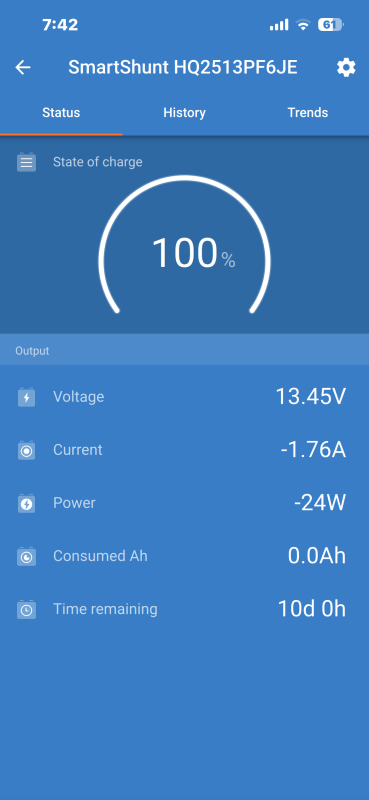
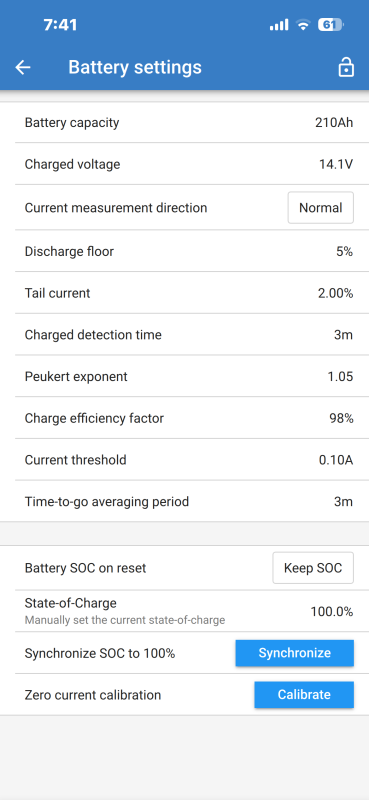
OK. So, I hooked up the shore power overnight to let the batteries fully charge. I disconnected the master switch for about an hour to let things settle out. Then I went into the app and hit the synchronize SOC to 100% button. I am attaching a snapshot of the various calibration settings I used based on several references which I assume are pretty close to good for my system. Then I turned on the master switch to put a load back onto the battery. I have no lights or refrigerator on anything I overtly have powered up. As you can see, it shows a draw of 1.76 Amps. That seems to me to be a lot and will drain the battery in ten days (though my math would say less than that.) Maybe something is going on just now and it will settle down, but this comes back to the very original question I had on this thread: Where are the power draws coming from when supposedly most of the power is off that is still killing my batteries? Any thoughts?
 0
0 -
JHornby
A baseline draw for typical T@Bs as delivered is ~.35 amps. This is certainly the case for ours. Your reading of 1.75 amps is extraordinarily high.
Possibly by pulling the 12 volt fuses one at a time you can find which circuit and ultimately what component is causing this current draw.
The Victron Smart Shunt draws less than 1 milliamp (<.001 amp) per specifications. Even the .25 amp measurement indicated is far too high for it alone.0 -
@JHornby I agree with @rfuss928 but wanted to acknowledge your great work in getting the shunt installed. Your problem would have been a literal shot in the dark without the data you have now.
I too was hesitant about working on my trailer but with the support of the forum I have gained so much.
And the baseline draw in my 400 is similar, well under 0.5 Ah2019 T@B 400 Boondock Lite towed by 2016 5.7L Toyota Tundra
1 -
Have a look at your battery manual and check on the "Charged Voltage" or "Absorption Voltage" For many lithium batteries, the charged voltage should be "somewhere" around 14.4 to 14.6. So, 14.1 "might be" just a little low. The "Discharge Floor", which is used for the "Time To Go" calculation, should be set to "zero".Let's also have a look at the Solar Controller settings.This is the Battleborn page for setup for the Shunt for their batteries. There are a lot of discussions across the internet about the "tail current", for example. Check the LiOn battery manual to see their recommended settings for charged voltage, etc. They probably do not differ very much from these values.Lets also make sure your Solar Controller is properly set up for lithium charging.As far as this drain goes, though: has there been any modification of something like the reading lights? The 12V ports? Do you have something like a phone charger or some other device simply plugged into a port? Is your 12V fridge completely "off?"This is a thread about a 12V fridge that is "constantly running" due to a bad thermostat. The suggestion of turning off the various breakers and pulling one fuse at a time while watching your Victron react would be the best way to go about this process of elimination.Towed by 2014 Touareg TDi0
-
QHumberd,
Thanks for the compliment. This is pretty challenging for me, but it looks like the shunt is working and already I can see how valuable it is going to be to figure out how much draw almost everything puts on my battery array as well as just know where things are at. It's actually kind of fun! And again, without the folks on this thread I'd be dead in the water, starting with the suggestion to not only use a shunt, but exactly what one to get.
Pthomas,
I had mostly referenced this video for guidance on how to set the shunt up: Victron SmartShunt settings explained in detail
I looked at a few other sources, but here is the page from the owner's manual for the battery itself attached. I called it "battery specs".
I can look at some of the other things you suggest here in a bit.
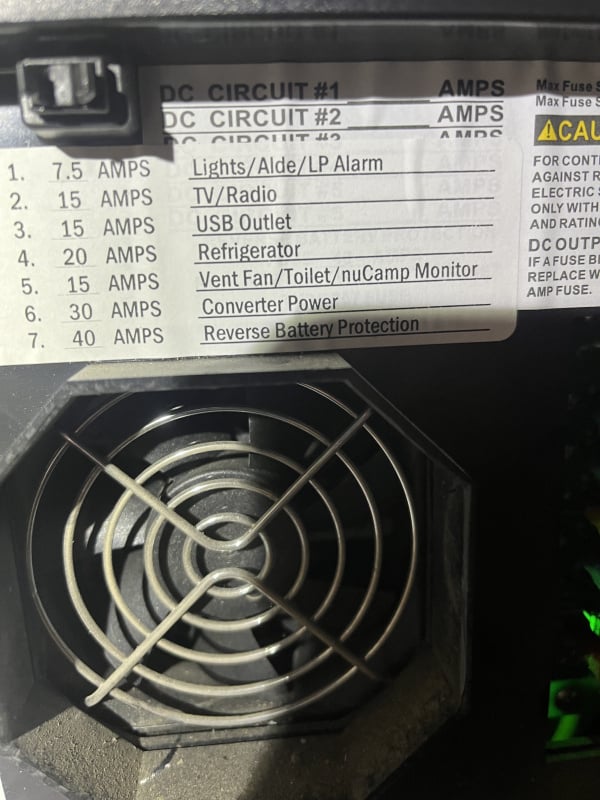
That said, I did some troubleshooting by pulling the fuses as suggested by RFuss. Here is what I learned as I pulled each fuse one by one... first, see the attached photo of the fuse panel for reference for what it controls as I go through each one by one. That photo is called "Fuse Panel".
1. When I pulled this fuse, the amps dropped from 1.75 to about 0.45. Wow. I looked at the Alde control panel, and it turned out that even though I had no shore power or any designation on it to run the heater via electricity or propane, and therefore the trailer was room temperature, the panel itself was still on. When I powered off that panel, that is what dropped the amps from 1.75 to 0.45 basically. So, there was a lot of the mystery solved.
2. The TV/Radio... I went up to the Jenkins control panel, and actually turned it off. That reduced the draw by 0.07 amps.
3. USB Outlet. No significant draw.
4. Refrigerator. It is fully turned off, and the door is closed, and it showed no draw.
5. Vent Fan/Toilet/nuCamp Monitor. No draw.
6. Converter Power. No idea what this is, but when I pulled that fuse the entire amp draw went to zero. I assume this is some sort of master fuse that rules them all?
7. Reverse Battery Protection. No significant draw.
The last picture I am attaching I am calling the "Base Power", and that seems like it is the power from all the systems after I have turned off the easily controllable systems. You can see it is coming in at about 0.45 Amps, which seems like it might be in the acceptable range?
While I was at it, I did fool around with turning on various lights and the refrigerator, and it was really cool seeing how much draw each one added. The refrigerator of course ruled them all.
Oh, and one more thing. I just took a screen shot of the Victron Controller settings that manage the factory-installed solar panel on the roof of the T@B. Hopefully this helps figure out if I somehow screwed something up with that. It is called "Installed Victron Controller Settings".
Anyway, I feel like I (we) are getting close to "good enough" here. I'm looking forward to finding out how wrong I am!
Thanks!!!!!!
Harry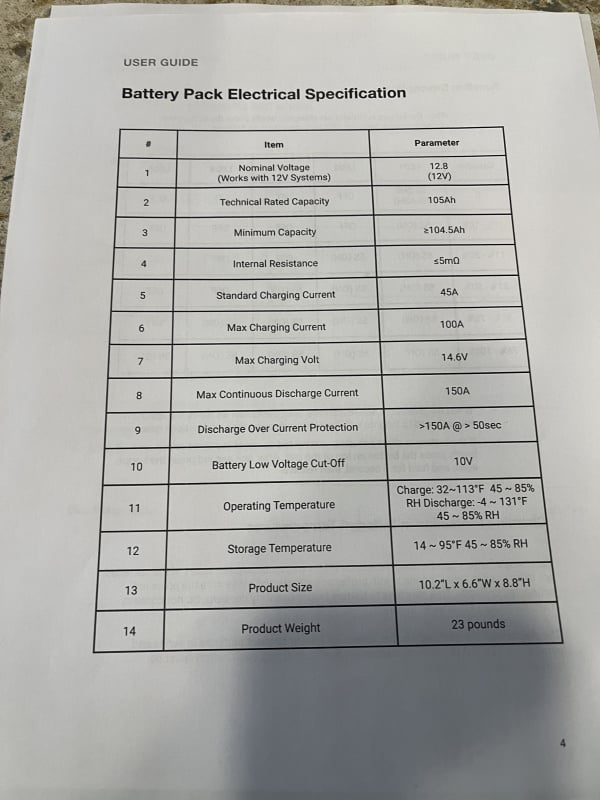
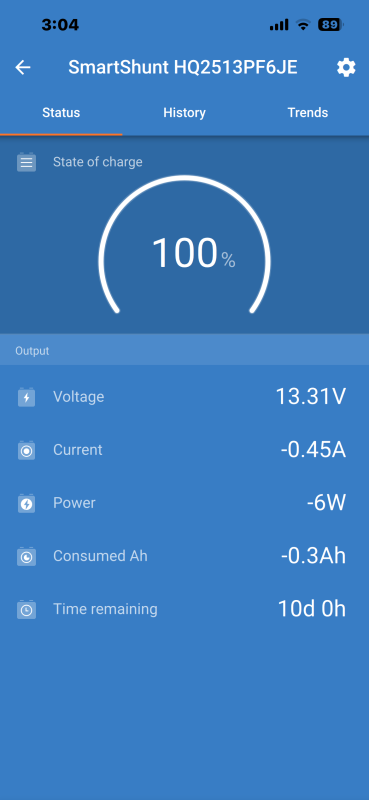
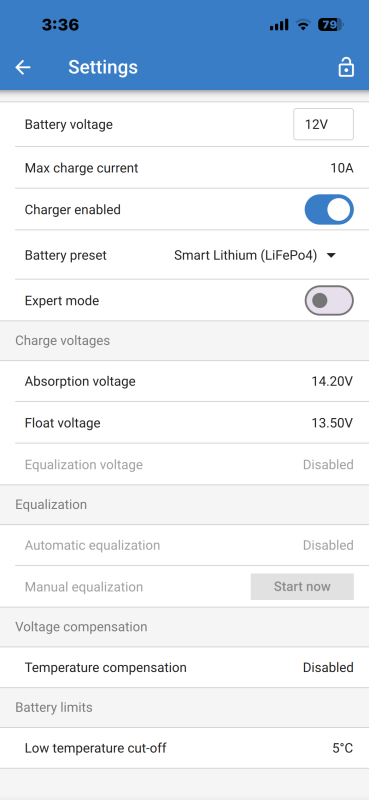
1 -
OK, all seems good, except now when I connect to shore power no current draws from the wall socket in the garage and of course, I can't charge the batteries now. Maybe I moved some wires around improperly.0


 2017 Outback



Categories
- All Categories
- 12 Cirrus Truck Campers
- 128 Dutchman and Vintage TaB Archives
- 3 Forum Rules
- 3 nüCamp & Forum Contacts
- 969 Air Conditioning & Refrigeration
- 2.7K Battery/Electrical & Solar
- 1.2K Camping & Travel
- 145 Events & News
- 220 Factory Comments
- 28 "FOR SALE" - New/Used Trailers
- 16 “FOR SALE" - Camping & Trailer Gear
- 2.4K Heating/Plumbing & Winterizing
- 138 Help - Computer & System
- 925 Introductions
- 408 Looking to purchase a trailer?
- 2.2K Modifications & Upgrades
- 1.4K Products and Accessories
- 425 Service/Maintenance & Recall Notices
- 37 Solo Travelers Hints & Tips
- 1 T@G Forum
- 78 Teardrop Groups & Links
- 78 Testimonials
- 922 Tips & Tricks
- 1.5K Trailer & Towing
- 27 Owners Manuals/PDF Files/Videos & Resources
- 56 üCamp Rally - News & Information